This is an announcement with a link

Woman reveals take-home pay from $95k salary and it explains why everything is broken

It sounds like a lot, but viewers couldn’t believe how fast her paycheck disappeared.

salary, money, paycheck, pay transparency, accounting, saving, economy, jobs, work, culture, cost of living, inflation
Photo credit: Canva PhotosA woman breaks down her $95k paychecks and people are surprised by what's left.

More money, more problems? Maybe not, but definitely some problems. Big ones. Making six figures ($100,000 per year or more) used to really mean something in America. It was a big milestone in someone’s life and career, signaling, at least from the outside, that they had made it. They were officially a success. Six figures never necessarily meant that you were rich, but it definitely set you up for a very comfortable life. You could afford a home, a couple of kids, yearly vacations, the works.

My, how things have changed.

One woman recently took to social media to share exactly how far her near-six-figure salary goes, and it’s not nearly as far as it used to be.

Kait Alayna, who posts on TikTok about personal finance, budgeting, and all things money, shared a video recently breaking down her $95,500 annual salary. (It’s not six figures, but it’s pretty close.)

“[My net paycheck] can seem kind of low for my salary,” she says in the video, responding to a commenter. “So here’s the breakdown of gross to net so you can see where all the funds are going.”

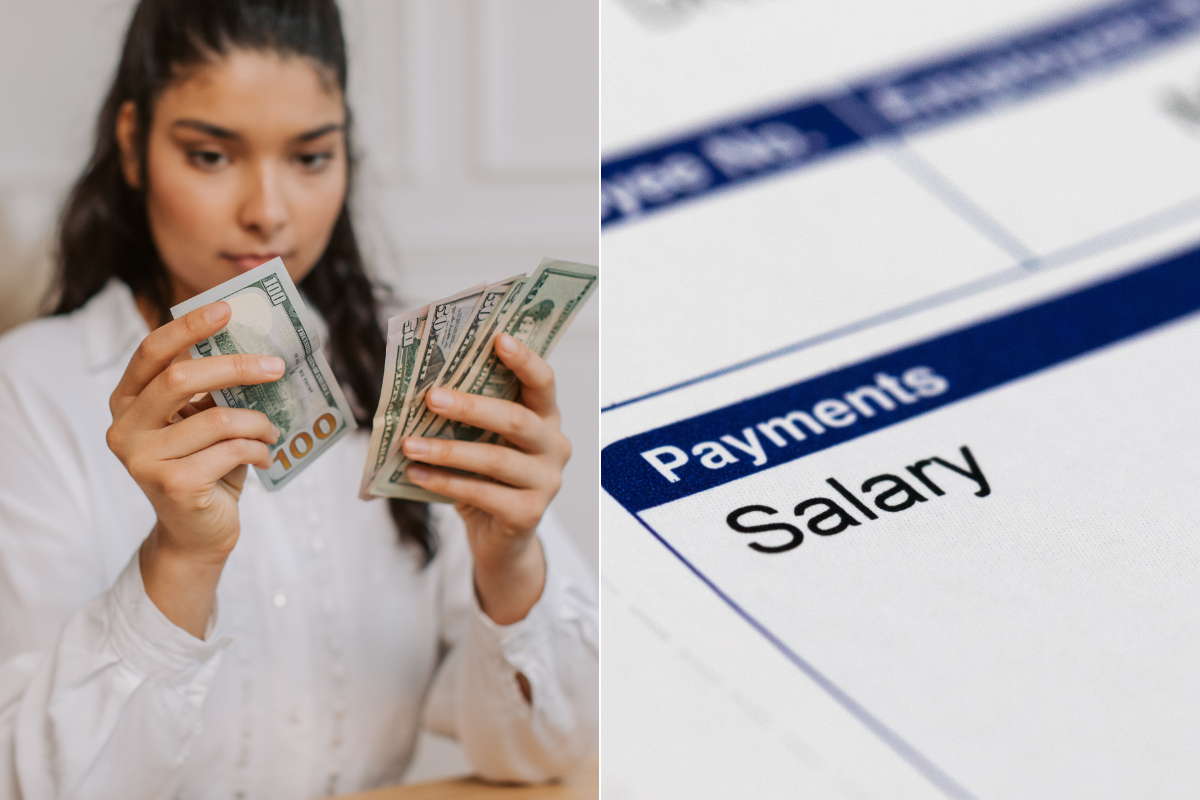
In captions on the video, she shows that her gross paycheck is $3,979. $399.91 goes to her 401k contribution. Seventy-five dollars go to a health savings account, and she pays another $68.88 per pay period for health, dental, and vision insurance. A chunky $882.30 is taken out of her paychecks for taxes.

That leaves her with just $2,553 in her pocket per pay period. That’s about $5,000 in monthly take-home pay.

For Alayna’s next trick, we get to watch it all disappear!

@moneywithkait

Replying to @Faith Hainey my semi-monthly gross paycheck -> net paycheck breakdown #paytransparency #salarytransparency #paycheckbreakdown #PersonalFinance ♬ original sound – money with kait ?

Five thousand dollars per month is nothing to sneeze at, of course! By all accounts, Alayna is doing great in her life and career.

But it vanishes from bank accounts faster than ever in the year 2025. In another video, she breaks down her monthly budget, which she shares with her fiancé:

Rent is $1780, and the total of all of their “essential” costs like groceries, gas, car insurance, cell phones, etc. is a whopping $4600 per month. Again, some of these costs are shared between two people, but that’s nearly all of Alayna’s paycheck swallowed up right off the bat!

Crucially, they’re spending an extra $700 per month on paying off debt like student loans, on top of the $550 mandatory payments. Together, they own over $60,000 in student loan and other debts. We don’t know the terms of their loans, but it often takes people decades (or even a lifetime) to pay down balances like that.

Commenters could relate to Alayna’s situation:

“I have the same salary, nearly the same deductions, and I take home $2200. We are in such a hard spot” one user wrote.

“I made $100k a year and only being home like $2400. FSA, 403b, retirement pension, taxes, college savings. Sometimes I’m like where is my money?!” one added.

“I make $145k and my take home after insurance, taxes, 401k, etc is $3800 bi monthly, I cry when I think about it” someone wrote.

“Mine is about the same. Once rent and car payment is taken out, just enough for groceries and like one night out,” a commenter said.

“My salary is $95,481 and my net is super close to yours. It just doesn’t go as far as it used to!” added another.

“Money doesn’t buy what it used to. All of the necessities are priced up,” someone summed up.


Making nearly six figures per year puts people like Alayna in a comfortable and enviable position. But the hype still doesn’t match the reality in 2025.

Though it’s enough for a comfortable life, it’s still very difficult at that salary level to save for a house, travel regularly, retire early, or even have a family—you know, the fundamental promises America was built on. Alayna and her fiancé have to be extremely disciplined with putting money aside to ensure they can withstand emergency costs and go on the occasional vacation.

Fortune writes that, “A six-figure salary used to be considered wealthy—but now, most of these earners are struggling to stay afloat amid raging living costs and salary deflation. That’s because households making $100,000 annually are still considered ‘middle-class’ in every U.S. state.”

Even earning $200,000 per year isn’t considered upper-class in many places. Fortune adds that over half of Americans earning a six figure salary still described themselves as living paycheck to paycheck, and that number is growing every year.

Why? It’s because this whole time that we’ve been thinking people who make six figures are “rich,” the cost of living has been accelerating upward at breakneck speed. Groceries are about 25% more expensive than they were just a few years ago. In the last 10 years, the median home price has gone by over $131,000. The average cell phone bill, with smartphones now being a near-necessity to be a participant in modern society, is now about $141 per month. The federal minimum wage has not changed in that time, nor has it since 2009.

It’s time to reset our expectations of what a living wage really is, and even who we consider to be rich. If someone who makes the coveted $100,000 per year is still living paycheck to paycheck, living and dying by the budget spreadsheet, and devoting a huge chunk of salary to paying off debts, what hope does anyone else have?

Alayna writes that she’s thankful for her job, and she’s making it her mission to help others with smart budgeting and money decisions. But until a carton of eggs becomes affordable again, almost everyone’s going to have a tough time getting ahead.

  • 16 frugal living tips from around the world that might help Americans save money
    Photo credit: Image via Canva/Aflo ImagesInternational frugal living tips for people in the United States.

    People around the world have one major financial goal in common: save more money. Living a frugal lifestyle and cutting overall living costs is something that unites us all, regardless of the country we live in.

    While Americans also prioritize putting money away, others nationalities are better at it. According to GoBankingRates, the top five countries that save the most money are: Slovenia, Morocco, Sweden, Sri Lanka, and South Korea.

    Frugal people from around the world shared their best frugal tips on the subreddit r/Frugal from their cultures that people in the United States can use. These are 16 of their best money-saving tips.

    “Most highly specialized cleaning sprays don’t exist outside of the US. You don’t need 7 different sprays for every surface in your kitchen/bathroom.” – Ajreil

    “Buying a whole chicken and breaking it down is cheaper than buying pre-cut pieces. For millions of families breaking down a chicken is just part of shopping day.” – Ajreil

    “Buy produce when it’s in season and cheap, then pickle/dehydrate/ferment it to preserve it for the winter. Many cultures prepare 6+ months of produce during the summer.” – Ajreil

    “Line Drying clothes in the sun rather than use a dryer bc it’s not standard to have a dryer in most places around the world. I set this up on the balcony of my American home and it preserves my clothes and saves energy!” – krickitfrickit

    “The big one is having multi generational households, it’s a far bigger savings than anything you can list.” – Dismal-Bee-8319

    “I moved to Ireland and the way most people heat their homes here is to have the boiler turn on with a timer in the early morning for about two hours (eg 4-6am). This way the house is warm in the morning, then by afternoon the houses are oriented towards the sun and warm up that way. By the time the heat wears off in the evening, it’s time for bed. We had oil heat and radiators in Connecticut before this, a colder climate but the same system except with thermostats instead of timers, and I’m shocked how little oil we actually burn here. We filled our tank in April and the supply company said most Irish homes wouldn’t have another delivery until after Christmas.” – breadit124

    “In the hot summers, when I wake up I open my living room window and have a fan pointed towards out and turn it out the highest setting and then I open the bedroom window (my place only has 3 windows). What happens is with the fan pointing outwards instead to the inside of the house it is drawing out the warm/humid air from inside the house and pushing it outside and the other window is drawing in the cool air. Within about 1/2 – 3/4 of an hour I can reduce the humidity level in my place by about 10% and lowering the temperature by 2-3 degrees depending on how hot it is inside and cool outside or how long I have the fan turned on.
    I do this until about 9am when it starts warming up then turn off the fan, close the windows, close the blinds/curtains and my place is nice and cool inside all summer doing this every day. It is very noticeable just how much cooler the inside my home especially when I go from the outside to the inside. For my bedroom, to sleep, I have a ceiling fan above the bed.” – Rexzies

    “Buying whole chickens is actually more expensive for me here in the US. I used to do it in the 90s every month when I got groceries, but something changed and it was actually cheaper to buy rotisserie chickens or bogs of frozen thighs from the restaurant supply. Now? I buy Costco rotisserie chickens and break them down every month. Kind of like I used to, but pre-cooked.” – EducatedRat

    “Not constantly buying stuff? Americans really don’t understand or appreciate just how much nonsense we buy. In 2022, U.S. household final consumption accounted for 34% of the world’s total, when we’re only about 4% of the global population. Part of it is the average US household does have more income than households in other parts of the world, but we use that to just buy loads of utter…..sh*t.” – hyperside89

    “Not a ton of single use disposable things in the kitchen like – cleaning wipes (use rags), paper towels (use rags), ziploc bags (use reusable tupperware), clingwrap (put the thing in bowl with a small plate/lid on top).” – considerfi

    “We cooked pasta by bringing the water to boil and letting it cook for a minute. Then stirring a few time, covering the pot, taking it off the heat, and letting it sit for about 10 minutes. We did this because cooking gas was expensive. It was important to avoid opening the lid too early because it would let out the heat that was needed to cook the pasta.” – Mission_Sir_4494

    “Eat more canned and dried fish. People in Mediterranean countries and in Latin America and the Caribbean eat dishes made with canned fish such as tuna, sardines, salmon, mackerel, herring and different varieties of dried fish regularly. It’s cheap, high in nutrients, versatile and widely available.” – Clear-Taste-7178

    “In France, I buy laundry shavings, dissolve them in hot water and have laundry detergent. I bought some for €50 2 years ago and I only used 50% of the shavings. It also works for washing lots of things, from floor to ceiling. For softener, I use vinegar. Same for the dishwashing machine. And I don’t have a car, I only travel by public transport (metros, trams, buses, trains, carpooling). Finally, I buy a large part of my fruits, vegetables, cheeses, meats and fish from local producers (it costs me less, it’s better, and I prefer to pay them for their work). All this can be quite common in France, but also in other countries I imagine.” – Puzzleheaded_Ear1950

    “Cook at home. We make every meal at home, family of 5 and both parents work full time. Do a weekly shop and take the time to cook all meals from scratch. But then, eating out in Norway is very expensive. Make sure to have little to no food waste.” – Bookkeeper_Best

    “While showering we don’t let the water run while we put soap all over our body. And showering everyday is not always a thing. To shower, 3 steps. You wet yourself. Stop water and use soap. Rinse the soap. Done. I still don’t get how one would run the water while putting soap on: doesn’t it rinse the soap before it has had time to be on your skin and actually clean you?” – theelefantintheroom

    “Plug in air fresheners, spray air freshener and scented dryer beads. Unnecessary spending and potentially harmful for the health of your family. What are you breathing in when you spray those chemicals? Open a window. Wash your floors. Smoke outside. Put blankets down where pets sleep and wash them regularly. So many things we can all do instead of spraying artificial crap into the air we breathe.” – Canadasaver

  • Frugal people share the best money-saving advice from parents and grandparents they still use
    Photo credit: Images via Canva/spxChrome, irynakhabliukPeople who live frugal lifestyles share best frugal advice from older generations.
    , ,

    Frugal people share the best money-saving advice from parents and grandparents they still use

    “My mother taught me how to compare prices per item or ounce rather than by the package.”

    For those with great grandparents, grandparents, and parents from the Greatest Generation (those born 1901 to 1927) and the Silent Generation (those born 1928 to 1945), much can be learned from how to live a frugal lifestyle. These two generations lived through the Great Depression and World War II, two events that forced Americans to become more resourceful due to difficult financial situations, food scarcity, and rations.

    Today, people who consider themselves frugal are always looking for more ways to save money. To glean frugal wisdom from older generations that would still be applicable today, one frugal person posed the question on Reddit: “What frugal lesson from your parents or grandparents you still use today?”

    And many frugal people offered their best money-saving tips from their relatives that they still use today. From how to save on money to utilities, these are the best frugal tips from Redditors:

    Reuse from your kitchen

    “My grandma rinsed and reused foil until it crumbled. I rolled my eyes then, now I catch myself doing it. Funny how those ‘silly’ habits end up smart. Mine also saves glass jars, labeled lids with tape, turned t-shirt into rags, and froze veg scraps for stock. :)” – YourxCherry

    “I save butter wrappers in the fridge to use for greasing baking pans. To get everything out of empty condiment bottles, I pour a little vinegar, milk or whatever is fitting, then shake it up and use that for salad dressing or other cooking needs.” – so-many-cats

    “I love Tostitos salsa jars. Whatever I cook, such as soup, ground beef, pasta, the extras, or leftovers, everything goes into these jars. They are so perfect for portioning. One jar = one person’s meal portion. I literally have more than 30 jars, and they are incredibly convenient!” – Proud_Possibility256

    “I do not go grocery shopping until my fridge is empty including my freezer zero food waste. I have become very creative with recipes. Saves me money. Always take lunch to work.” – Samantha-the-mermaid

    “My grandmother took care of her five siblings during the depression after her parents died on .45¢ an hour. I make more money in an hour than she made in a week. She never wasted ANYTHING. She taught me to save bacon grease for seasoning, bread ends for bread pudding, leftovers for soup, and coffee grounds and eggshells for the garden. We didn’t carve our pumpkins- we painted them and made pumpkin pie out of it after Halloween.” – That-Response-1969

    “I sometimes hate it that I am like this, but one of the first odd things that come to mind is labeling bottles of home goods like dish soap, body wash, bars of soap, hand soap, etc. so you know which one lasts the longest after purchase. Keep in my mind, my grandmother grew up during the Great Depression. I also spent a majority of my days with her making food (predominately just standing around doing nothing useful). All of the meals we hold dear to our hearts are actually just frugal meals to stretch out. She would get extremely nervous if she came to your home and there were not canned goods. This is winter in the upper Midwest during the Great Depression to put it into perspective, along with canning and preparing for everything. This is a person that lived by candle light basically. When she finally had a icebox, every last meal had to be frozen. No matter what you made, it had to be able to sit there when necessary. You make no meal that cannot be eaten for three days or frozen solid for the next month. I still live by this routine.” – WideRoadDeadDeer95

    Make your money go further

    “My mother taught me how to compare prices per item or ounce rather than by the package.” – Chicpea09

    “My parents always framed purchases by how much time I would have to exchange for the item. So when I was in 6th grade and I wanted a TV for my bedroom and it was $120, I would have to do 6 to 10ish baby sitting jobs – then ask myself is it worth that exchange. This is still how I frame most purchases.” – BagNo349

    “My grandfather told me as a teenager that debt is how other people control you. I didn’t realize how true this was until my early 20s when I got into mild debt problems. Since then I have been majorly debt averse.” – Egon88

    “Mine told me if you cant pay the milkman 6pence this week, how will you pay him 12pence next week? Lesson learned. I pay my bills on time ALWAYS.” – Mundane_Sail_4155

    “My dad always said it’s not a deal if you can’t afford it. Of course he didn’t have slickdeals either lol.” – JasonG5

    “My grandpa always said ‘Pay yourself first.’ Even when money was tight, he’d stash $5–10 in savings before paying bills. I thought it was silly but that habit built a nice cushion over time.” – samdaz712

    Save on utilities and living expenses

    “I hang dry my clothing whenever possible. I find it strangely relaxing to stand outside and carefully hang everything up so it has good airflow. It reminds me of helping my grandmother hang out laundry on their farm. The only thing I changed was painting the tips of my clothespins so I can see them better and don’t forget them on the line accidentally.” – SpecificSkunk

    “MAINTAIN and REPAIR what you already own. Lubricate, tighten, clean. Change filters. Replace belts. Flush. Air out. Condition. Resurface. Store properly. Take care of your stuff.” – i_know_tofu

    “I patch and repair clothes that can be repaired instead of immediately buying new. For instance, we have a comforter that has gotten holes from the washing machine – cheap materials. I’m learning the Japanese art of Shashiko to patch it over my Thanksgiving week break. I find a used item instead of buying new immediately, when our dryer went out, I bought one from an estate sale for the same price as repairing the old one would have cost (and since it was on it’s 3rd repair – heavy eye roll on cheaply made crap – I don’t feel so bad. I line dry a lot of things. Not everything but a lot.” – LeftwingSH

    “I put on hoodies and blankets and refuse to turn the heater on until the outside temps are about 45 degrees.” – thedoc617

    “How to drive in order to maximize your miles per gallon and reduce wear and tear on the car. Accelerate slowly and try to keep under 2 RPMs. Leave a wide berth between yourself and other cars. Anticipate traffic/stopping, then let off the gas and cruise. Don’t ride the brakes.” – OrdinarySubstance491

  • Why Millennials have single-handedly saved the greeting card business from going under
    Photo credit: Image via Canva/Leeloo The FirstGreeting card.
    ,

    Why Millennials have single-handedly saved the greeting card business from going under

    “It’s always nice when you can tell someone knows you and picked out a card that is your vibe. Makes you feel seen and valued.”

    There’s something special about receiving a physical, handwritten greeting card. Whether sent by snail mail or attached to a sweet gift, greeting cards are still alive and well in the digital age of communication.

    According to the Greeting Card Association (GCA), 6.5 billion greeting cards are purchased annually in the United States. And one generation is to thank for saving the industry: Millennials.

    “The millennial generation is now the largest buyers of greeting cards from a dollar standpoint,” said George White, Founder of Up with Paper, a pop-up greeting card company, and Past President of GCA, per the U.S. Chamber of Commerce.

    “[Millenials] saved our industry.”

    card, greeting card, cards, opening card, reading a card
    Valentines Day Love GIF by Julie Smith Schneider Giphy

    Carlos Llanso, Director of Strategic Initiatives in The Greeting Card Association, added that Millennials and Gen Z are both strong greeting card consumers. “They have friends they will text or post happy birthday to, but then they have those who are ‘card-worthy,’” he added.

    The deeper significance of greeting cards

    Sending messages and communicating online is constant, immediate, and often fleeting,” Dr. Pamela Walters, MD, consultant psychiatrist at Eulas Clinics, tells Upworthy. “Messages can be sent and deleted within seconds. Cards can feel slower and more deliberate which is why many people keep cards for years.”

    And they can help us connect on a deeper level. “As human beings we attach meaning not just to words but also to the medium through which those words are delivered. A physical card represents time, effort, and thoughtfulness to a lot of people,” adds Dr. Walter. “It signals that the sender has slowed down to acknowledge you personally. For millennials (who, let’s not forget, came of age during the shift to digital communication), the tangible nature of a card can feel more special. Psychologically, these little things that show care can definitely strengthen bonds.”

    snail mail, sending mail, mail, card, greeting card
    Mail Send Me GIF by alimacdoodle Giphy

    Of course, greeting cards also bring an air of nostalgia. “There is also a bit of a nostalgic element. They experienced writing thank you notes as children but also grew up texting and on social media,” says Dr. Walter. “That duality means they appreciate the novelty/intimacy of something older fashioned.”

    Millennials are pumped that they “finally saved something.” One explained, “It’s exciting to get something personal in the mail. Plus it’s always nice when you can tell someone knows you and picked out a card that is your vibe. Makes you feel seen and valued. I’ll slap them on the fridge for a bit.”

    mail, opening mail, card, cards, greeting cards
    Send Me Spongebob Squarepants GIF by Nickelodeon Giphy

    Another commented, “I keep almost every card I get/have ever gotten. Someone took the time to think about the perfect card to give me, and then also wrote a personalized note inside.” Another shared, “I love getting cards, especially when someone writes a message. I keep mine. If they’re holiday cards, I display them annually.”

    Other Millennials shared where they like to buy their greeting cards. “I buy them from the dollar store because they’re not worth $7-$10,” one wrote. This one added, “Trader Joe’s sells greeting cards for $1.” Another wrote, “Aldi sometimes sells bulk blank cards for $5. I have a ton. Also, check for bulk cards if a child family/friend is having a school fundraiser. Sometimes the ones with wrapping paper have bulk blank cards.” Another spilled, “Marshall’s has some really cute fancy ones for under five dollars too.” And another added, “I grab them from Homegoods when they put them on clearance at the end of a season.”

Health

‘Fear-setting’: How a bestselling author conquers anxiety by writing down worst nightmares

Health

Doctor’s unique ‘4-7-8’ relaxation technique could help you fall asleep on-demand

Joy

Dogs really do have favorite people, and here’s how they decide who it will be

Music

Ethan Hawke puts the ‘Who’s your favorite Beatle?’ debate to bed forever in passionate exchange