This is an announcement with a link

It’s time for every American to take a deep breath, step back, and have a long look in the mirror

Yes, every single one of us, whatever our political persuasion.

america, united states, polarization, political division, partisanship
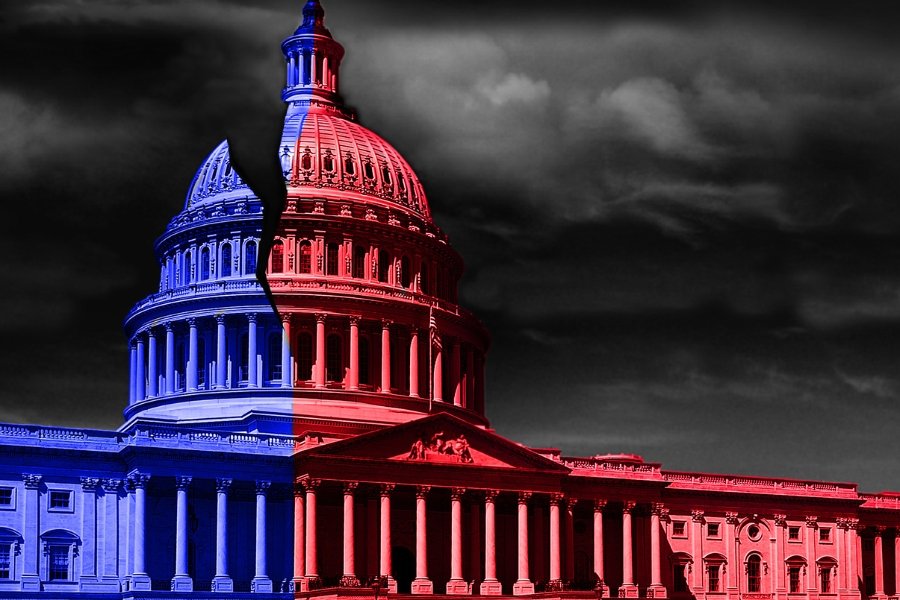
Photo credit: CanvaPolitical polarization is out of control. It doesn't have to be this way.

What I’m going to share here may well be futile, and many people who need to hear this message and take it to heart probably won’t. But America is at a precipice we’ve been hurtling toward for years, and if we don’t do something now to slow the momentum, I fear we’ll soon find ourselves plummeting over a proverbial cliff, one and all. It’s worth an attempt to pull us back from the brink.

We all know that political polarization in the U.S. is reaching a fever pitch. What many people don’t seem to recognize is how they individually play a role in it, especially those who are adamant that the “other side” is to blame for the division. As a lifelong political independent, it’s been terrifying to watch my fellow Americans become more and more entrenched in hyper-partisanship, seemingly unaware of how they themselves are contributing to the problem, simply by allowing themselves to be pulled further into the partisan binary.

left, right, politics, partisanship, political ideology
We can't divide America into Photo credit: Canva

Democrats say Republicans are the problem. Republicans say Democrats are the problem. The vast majority of us absentmindedly use black-and-white ideological terminology that line up with our political parties to describe our fellow Americans—liberal or conservative, left or right, red or blue—as if 342 million people fit neatly into two political/ideological boxes. As a result, many Americans have found a home and an identity in those boxes, and unfortunately, some have built them into fortresses from which to shoot at the other side—figuratively and literally.

But no matter how people feel about one box or the other, neither of them is really the problem that brought us here. The problem is the premise that they are built on, which is that there are two opposing sides in the first place. It was inevitable that partisanship in a two-party system would eventually lead to an intractable division featuring extreme, binary thinking pushed by those who benefit from that polarization. The “other side” isn’t just different, it’s depraved. The “other side” isn’t just misguided, it’s malicious. The “other side” isn’t just wrong, it’s evil. This kind of thinking is a feature, not a bug.

george washington, party politics, two-party system, farewell address, partisanship
George Washington tried to warn us about the perils of partisanship. Giphy

George Washington tried to warn us about this in 1796 when he said that the “spirit of party” was America’s “worst enemy” and would eventually lead us to our demise. We’re right there, right now. Partisanship has been fully weaponized by those seeking and wielding power, pitting Americans against Americans, convincing them that the “other side” isn’t just wrong, but evil. (“But the other side really is evil!” you might be thinking. Thank you for proving the point. The “other side” says exactly the same thing.) The walls of those political and ideological boxes have gotten so high and so thick that we’ve lost the ability to see one another’s humanity.

Many things have gone into how we got here, of course, and there’s plenty of blame to be tossed around. But instead of finger pointing when we talk about our polarization problem, what if we were to look inward and own our own individual part in it, whatever that might be?

I would love to invite every American of every persuasion to take a pause, zoom out, and honestly engage with these self-reflection questions:

Do I tend to label people as liberal/left or conservative/right based on what I know about their beliefs?

Do I assume a certain political party affiliation based on what someone looks like/how they dress/where they live?

Do I describe states and cities as “blue” or “red” and make judgments about those places based on those labels?

Do I use generalized terms like “the left” or “the right” to describe large swaths of the American population?

Does the media I watch or listen to speak in those binary terms? Is one used positively and one used negatively?

politics, political divide, polarization, division, party politics
Partisanship is divisive in its very nature. Photo credit: Canva

Do I check multiple sources to find what’s true before I react or form an opinion about something I see on social media?

Do I seek out a variety of commentary to genuinely try to understand different perspectives?

Do I contact my legislators when I want to see a change in policy, or do I just argue with people on social media about it?

Do I recognize when people are debating in an effort to seek truth and when they’re using rhetorical tricks to “win” an argument?

Am I spending more time engaging with people online than I am in real life?

Do I pay more attention to the extreme voices on the political spectrum than to the moderate ones?

Am I aware of how social media algorithms affect what I see and am exposed to?

D
o I see how the extreme element of the “side” I most align with is being used to paint my political persuasion in a negative light?

Do I see how the same thing is being done with the extreme element on the other “side”?

Do I acknowledge when someone from my “side” shares misinformation? Do I call it out?

misinformation, b.s., fake news, falsehood, calling out
There''s b.s. all over the political spectrum. Giphy

Do I think of a large portion of my fellow Americans as enemies or adversaries? Why do I view them that way?

Do I want to see my fellow Americans as enemies or adversaries? How can I see them differently?

Am I suggesting we stop using labels like left/right, liberal/conservative, etc. altogether? As much as possible, yes. These labels barely help us understand one another anymore—most often they are used to stereotype people or to take one person’s objectionable action and ascribe it to the entire “side.” So much of our current situation is a result of the extreme generalization of Americans into two groups, when in reality, very few people actually think, believe, live, and act within the confines of however those group labels are defined. Most of us know this intellectually, of course, but it’s so easy to be pulled by language to one extreme or the other in a polarized political climate, especially via social media.

That polarization is purposeful, by the way. Giving people a political identity and an “other side” to fight against is one of the easiest ways to gain political power. Unfortunately, it’s also playing with fire. (And if you think only one party does it, think again. It’s just much easier to spot when it’s done by people we disagree with.)

We can’t solve our problems using the same means by which they were created. We can’t change the politics that weaponizes partisanship if we ourselves are furthering and fueling it with partisanized thinking and rhetoric. We can’t respond to political and ideological extremism with more extremism, even if we think our extremism is justified. Literally every extremist thinks their extremism is justified. Black-and-white, us vs. them thinking is extremism. It’s becoming so common, we’re getting numb to it.

None of us is immune here—this stuff is designed to tap our most primal instincts—but we have to fight it in ourselves. When we feel a push or pull toward binary extremes (which is easily mistaken for believing we’re on the righteous side of things) we can consciously pull ourselves back to a place where we see one another’s humanity before everything else.

I’m not both-sidesing here or implying that there aren’t any legitimate issues with any particular party/side/ideology. What I’m saying is that partisanized discourse has become a zero sum game and too many Americans are willingly being used as pawns in it. While we can’t control what other people do, we can reflect on the part we as individuals play and dedicate ourselves to being part of the solution instead of contributing to the problem.

Of course, stepping away from political labels and partisanzied discourse won’t instantly solve all of our issues as a nation. But if enough Americans refuse to play the partisan game and reject the binary rhetoric of left/right, liberal/conservative, red/blue, Democrat/Republican, perhaps we can help prevent the U.S. from plunging into the dark, dangerous chasm we’ve found ourselves at the brink of.

It’s worth a shot, at least.

  • Folks on ‘left’ and ‘right’ share one thing they respect about one another. It’s giving hope.
    Photo credit: Courtesy of Ashley Rankin @gynaminte_/TikTokLooking at the positives of the other side makes it a lot harder to hate.
    , ,

    Folks on ‘left’ and ‘right’ share one thing they respect about one another. It’s giving hope.

    As one person wrote, “This is the most mature comment section I’ve seen.”

    The United States feels on edge right now, with passions running high and partisanized rhetoric ramping up in the days following Charlie Kirk’s assassination in Utah. For non-extremists, it’s disheartening to see people on both “the left” and “the right” being painted in sweeping brush strokes filled with vitriol.

    Most of us don’t live like this in our everyday lives. Most of us don’t live at extremes and are capable of nuanced thought. We acknowledge that the world’s problems are complex and know that we aren’t always going to agree on every solution. While we may disagree, sometimes vehemently, we don’t paint half of our fellow Americans as the enemy.

    america, united states, polarization, political division, partisanship
    Political polarization is out of control. It doesn't have to be this way. Photo credit: Canva

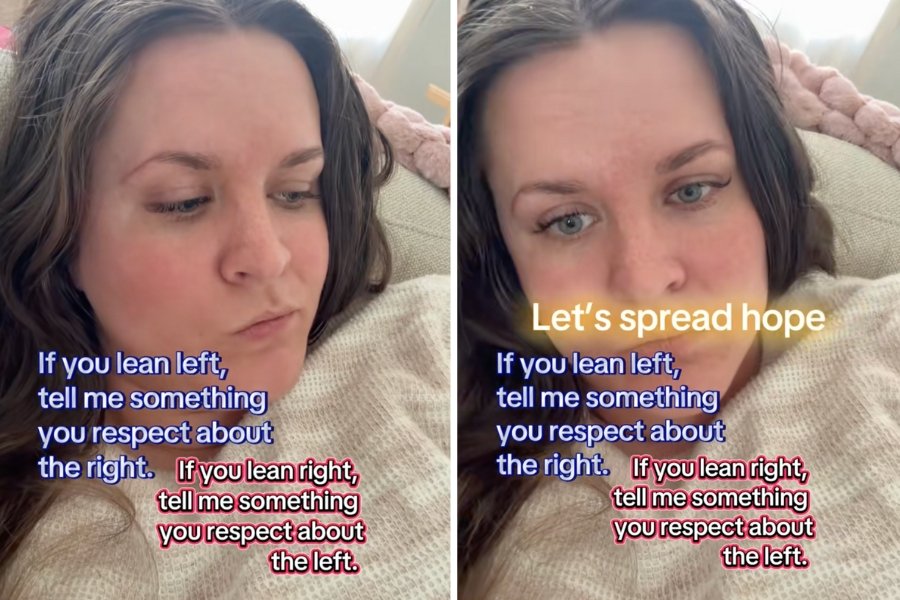
    A woman in Utah, Ashley Rankin, was feeling overwhelmed and confused about the state of the country when she decided to make a video plea for compassion and understanding. “While recording, I zoned out for a second and my face perfectly captured how I felt in that moment,” she tells Upworthy. “I dropped the words and thought, rather than telling people to spread love, hope, and compassion, I want to see what they will do, when presented with the opportunity.”

    So she overlayed her few-second video with “If you lean left, tell me something you respect about the right. If you lean right, tell me something you respect about the left,” adding, “Let’s spread hope.” She asked viewers to fill her comments with positivity, and in a miraculous flip of the script we so often see online, people delivered exactly what she asked for.

    @gynamite_

    Please fill my comments with positivity! I live in Utah and things feel heavy here. #bridgingthedivide #HopeInHumanity #BetterTogether #UtahCommunity #positive

    ♬ Where Is The Love? – The Black Eyed Peas

    The comments filled up with people leaning one way or the other—sometimes even pretty far to the left or right—expressing their respect and admiration for various characteristics and beliefs of the “other side.” It’s truly a beautiful outpouring that demonstrates how much closer we are than we think:

    “I am conservative, but I appreciate the left’s fight for free lunches and universal healthcare. I don’t believe anyone should starve or be denied medical care because they can’t afford it.”

    “Left here: I respect how the right heavily advocates for the farm and rural communities. We really do need to send more resources out to them and respect our farmers more.”

    “Lean right – love the passion of the left and how they always want to speak up for the smallest person in the room.”

    “Straight blue voter here. I do appreciate the conservative principle of fiscal responsibility for the govt. We may disagree how our tax dollars are spent, but I don’t disagree that govt is wasteful.”

    Season 19 Episode 10 GIF by The Simpsons Giphy

    “More conservative, but I love how the left advocates for preserving our earth, mental health, and resources for those who NEED them.”

    “As a Democrat I appreciate republicans patriotism and love for country and support for our troops and veterans. I just wish their representatives would vote to support those things that most of their constituents want to support.”

    “I’m more right than left, but I respect the left for their belief that you don’t have to be a traditional family to have family values. I actually agree with that.”

    “Leftist here I live in a deeply conservative, rural area. Whenever I’m in need, there’s help. Fresh baked bread randomly, the mechanic giving me free advice/discounts, fresh farm eggs cheaper than the store “

    “I’m mostly conservative. I appreciated the level of anger and ongoing fight regarding the undoing of roe v wade.”

    “Extremely left here, I appreciate how fiercely the right stands up for the working people; farmers, etc. I also am with them on getting violent criminals off the streets.”

    farmer, conservatives, liberals, right and left, politics
    People on the right tend to support rural life. Photo credit: Canva

    “I’m conservative. I do truly respect that the people on the left wanting gun control have good hearts and genuinely want the gun violence to end.”

    “Dear Left-leaning people, Thank you for your fight for immigration rights. I may not 100% agree with how we get there, but, everyone deserves the right to come into the country and to have a chance for a better life.”

    “By far the BEST comment section I’ve ever seen. I lean left heavily but I’ve always admired how persistent Republicans are at pushing legislation and the change they want to see.”

    Perhaps surprisingly, perhaps not, there was a ton of love for John McCain and Barack Obama coming from opposite sides of the aisle in the comments.

    “My family was always conservative, but everyone voted for Obama twice. Sometimes we have to accept that labels are for soup cans and vote for the person better qualified to lead.”

    “I’m a lifelong Democrat. I really loved John McCain! I thought he was such a well-rounded example of a true American patriot!”

    “I lean more right, but Obama was the last president I felt like we all respected.”

    “I don’t ‘lean’ left: I am left. However, I think John McCain also conducted himself with so much integrity. I think he tried to do a good job and actually cared about the people in this country.”

    “I am very Liberal and Canadian BUT when John McCain defended Obama against Muslim/ Arab attacks at his town halls…. I literally cried.”

    “I lean right, but I think the last time we had any dignity in politics, and I felt secure as a nation was when President Obama was in office. I think he’s an incredible leader, and he was the last time I trusted the person in power.”

    “I respect how John McCain stood up for Obama at one of his rallies and how he silenced the boos during his concession speech. Truly miss that kind of politics. Where we could disagree on issues but didn’t tear other down.”

    Mostly, though, people were just relieved and delighted to see how genuinely kind and heartfelt the comments were.

    “This comment section glued a tiny piece of my heart back together.”

    “These comments are not what I expected to see. It gives me hope that we are not as divided as politicians and media wants us to believe.”

    “Reading all these comments makes me realize that we should be fighting extremists (both left and right) instead of each other.”

    “This is the most mature comment section I’ve seen. This is the dialogue I want to see. It’s easy to speak to each other when we do it in a respectful way rather than resorting to name-calling and oppressing others.”

    We really do have more in common than the online discourse and political rhetoric from many politicians would have us believe. Social media algorithms may reward extremism, but videos like this and the responses they’re receiving are far more indicative of the reality most of us live in. Rankin’s video has accumulated over 10,000 comments and they are overwhelmingly positive.

    “I posted the short video hoping a few people would have genuine and respectful words, but was not expecting much,” Rankin says. “I had NO idea the impact it would have on me and so many others. The comments were exactly what my weary heart needed. I’m finally proud to be an American again.”

Health

‘Fear-setting’: How a bestselling author conquers anxiety by writing down worst nightmares

Health

Doctor’s unique ‘4-7-8’ relaxation technique could help you fall asleep on-demand

Joy

Dogs really do have favorite people, and here’s how they decide who it will be

Music

Ethan Hawke puts the ‘Who’s your favorite Beatle?’ debate to bed forever in passionate exchange