Fall is the season of sweet and crisp caramel apples, and as the treat becomes popular again, so does the longstanding debate about how to pronounces the sweet treat’s delicious coating. Is it carmel (car-mel) or caramel (car-a-mel)?
According to the Merriam-Webster Dictionary, “caramel” is “a usually firm to brittle, golden-brown to dark brown substance that has a sweet, nutty, buttery, or bitter flavor, is obtained by heating sugar at high temperature, and used especially as a coloring and flavoring agent.”
“Carmel” is a proper noun that denotes a town or place. As Professor Paul Brians at Washington State University and author of Common Errors in English Usageexplains, “Take Highway 1 south from Monterey to reach the charming seaside town of Carmel, of which Clint Eastwood was formerly mayor. Dissolve sugar in a little water and cook it down until the sugar turns brown to create caramel.”
So how do you properly pronounce caramel? Whichever way you pronounce it is technically right. June Casagrande, author of The Joy of Syntax: A Simple Guide to All the Grammar You Know You Should Know, writes: “The pronunciation ‘carmel,’ with two syllables, is every bit as acceptable as the three-syllable pronunciation. In fact, the two-syllable option comes first in Merriam-Webster’s dictionary, which may indicate it’s more standard.”
Different dialects across the United States have led to the difference in pronunciations in the United States. Back in 2013, Joshua Katz, then a doctoral student in linguistics at NC State University, created a map based on research from a Harvard Dialect Survey by Bert Vaux and Scott Golder that showed which regions pronounced caramel with three syllables or two syllables.
How people in the United States pronounce caramel. Image via Reddit/sauihdik
Regional preferences are clearly laid out. “Car-a-mel” was more commonly used along the East Coast and South, while “car-mel” dominated in the Midwest and West.
Many people online discussed the different ways they pronounce it in the Reddit thread r/words. “The letters are there for a reason,” one commented. “There are three syllables. Pronounce them! :)”
Others were passionate about the two-syllable caramel pronunciation. “Cahr-mel, but I’m also in the midwest. I’ve never heard a person say ‘cah-rah-mel apples’ or ‘cah-rah-mel corn’ but I have heard people say, when talking about them on their own, ‘cah-rah-mels.’ I admit I probably say it wrong and I don’t care, cah-rah-mel sounds stupid to me.”
And some admitted to saying both, and being confused. “For me it’s context dependent. CAHRmul sauce, but ice cream topped with CAR a mel. So, depends if it’s in use as an adjective or a noun,” one wrote. Another quipped, “I’m from the Midwest and use them both but it’s context sensitive. Car-a-mels are candy, Carmel is sauce or flavoring. Why? I don’t know, it just sounds right to me.” Another shared, “But what about if you caramelize onions for cooking. ‘Carmelized’ sounds better to me than ‘caramelized’. Googling seems to agree.”
And one summarized the debate with a sweet story: “The debate on this is so relentless between my husband and me that it was literally included in our wedding vows. I say carmel, he says caramel,” they wrote.
Though many teachers are leaving the profession, not all of them are making national news. Maggie Perkins, 32, made headlines in 2022 when she quit the teaching profession to work at Costco, and showed no interest in looking back.
“The conditions were worsening rapidly, and I realized they weren’t getting better, and nobody seemed alarmed enough to do anything. I was 29 when I decided to leave,” she told People, noting she was making $47,000 at the time.
“The more I learned about Costco and the different roles at the company, the happier I was at the idea of working there, whether at the warehouse or corporate, for the rest of my career,” she added. “I feel like there was a great potential reward for pursuing it.”
Three years later, she trains fellow employees and has no regrets about leaving her former career.
Now that Perkins has been out of the classroom for a few years, she can say the things she couldn’t when she was working as an educator. So, she created a TikTok video where she revealed four big things that she had to keep to herself—and all of them are centered around kids’ hygiene.
“I used to be a teacher, and I couldn’t have said any of these things to your kid or to you while I was a teacher,” she opens her video.
What do teachers want to tell their students and parents but can’t?
1. Cut your child’s nails
“If your kid’s nails are long and dirty, other kids are noticing, and also it is gross. Kids literally get impetigo from their own fingernails,” she said.
2. Start using deodorant before they smell
“Please start putting deodorant on your kids before you notice that they need it,” she said. “Fifth grade, guys, fifth grade, deodorant.”
3. Your child needs to start wearing a bra sooner than you think
“It doesn’t have to be like a real bra. This is just like a soft, athleisure-type situation,” she said. “No one wants to be made fun of because it looks like they should be wearing a bra and they’re not.”
4. Wash that sweatshirt and hoodie often
“Once those cuffs start to be like literally brown and ratty, wash the jacket. I am watching them wipe their snot on the jacket sleeve day after day after day,” she said. “They’re walking around in a dirty snot rag.”
Perkins’ advice is for the child’s health, but also to save them from embarrassment.
“There’s no worse feeling than being a sixth grader who has this like acute sense of being different than others and criticized,” she said. “Your child is probably more aware of it than you are, and they’re just not talking to you about it, because kids don’t talk to their parents that much.”
The TikTok post, which garnered over 2.4 million views, resonated with Perkins’ followers, who shared how hygiene issues had caused them a lot of embarrassment when they were young.
“Parents, please also teach your kids to be compassionate because not all kids come from a loving home,” one viewer wrote. “Be the love they don’t receive and don’t make fun of the kids who may smell or are not wearing a bra.” Another added, “I would have loved for a teacher to tell this to my mom. I went to middle school without a bra, and I was so embarrassed to change in the locker rooms.”
Students in a classroom. Credit: Pexels/Arthur Krijgsman
Ultimately, Perkins’ tips are all about helping parents anticipate and address any potential hygiene or attire issues their child may encounter before they become a problem, whether that’s causing illness or embarrassment. The former teacher’s tips are a great reminder that a little extra care at home can make things a lot easier for kids on the playground and in the classroom.
This article originally appeared in May. It has been updated.
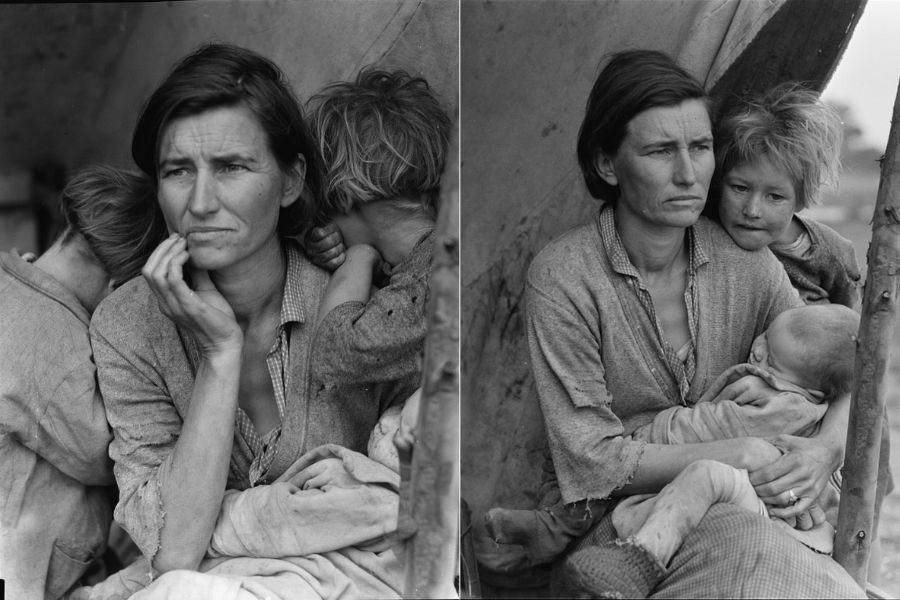
The woman from the famous Great Depression photo didn't know about her fame for 40 years. – Photo credit: Photo by Dorothea Lange via Library of Congress
Nearly everyone across the globe knows Florence Owens Thompson’s face from newspapers, magazines, and history books. The young, destitute mother was the face of The Great Depression, her worried, suntanned face looking absolutely defeated as several of her children took comfort by resting on her thin frame. Thompson put a human face and emotion behind the very real struggle of the era, but she wasn’t even aware of her role in helping to bring awareness to the effects of the Great Depression on families.
It turns out that Dorothea Lange, the photographer responsible for capturing the worry-stricken mother in the now-famous photo titled “Migrant Mother,” told Thompson that the photos wouldn’t be published. Of course, they subsequently were published in the San Francisco News. At the time the photo was taken, Thompson was supposedly only taking respite at the migrant campsite with her seven children after the family car broke down near the campsite. The photo was taken in March 1936 in Nipomo, California when Lange was concluding a month’s long photography excursion documenting migrant farm labor.
“Migrant worker” was a term used in the 30s to describe poverty-stricken Americans who moved from town to town harvesting the crops for farmers. The pay was abysmal and not enough to sustain a family, but harvesting was what Thompson knew as she was born and raised in “Indian Territory,” (now Oklahoma) on a farm. Her father was Choctaw and her mother was white. After the death of her husband, Thompson supported her children the best way she knew how: working long hours in the field.
“I’d hit that cotton field before daylight and stay out there until it got so dark I couldn’t see,” Thompson told NBC in 1979 a few years before her death.
When talking about meeting Thompson, Lange wrote in her article titled “The Assignment I’ll Never Forget: Migrant Mother,” which appeared in Popular Photography, Feb. 1960, “I saw and approached the hungry and desperate mother, as if drawn by a magnet. I do not remember how I explained my presence or my camera to her, but I do remember she asked me no questions. I made five exposures, working closer and closer from the same direction. I did not ask her name or her history. She told me her age, that she was thirty-two. She said that they had been living on frozen vegetables from the surrounding fields, and birds that the children killed.”
Lange goes on to surmise that Thompson cooperated because on some level she knew the photos would help, though from Thompson’s account she had no idea the photos would make it to print. Without her knowledge, Thompson became known as “The Dustbowl Mona Lisa,” which didn’t translate into money in the poor family’s pocket. In fact, according to a history buff who goes by @baewatch86 on TikTok, Thompson didn’t find out she was famous until 40 years later after a journalist tracked her down in 1978 to ask how she felt about being a famous face of the depression.
It turns out Thompson wished her photo had never been taken since she never received any funds for her likeness being used. Baewatch explains, “because Dorothea Lange’s work was funded by the federal government this photo was considered public domain and therefore Mrs. Florence and her family are not entitled to the royalties.”
While the photo didn’t provide direct financial compensation for Thompson, the virility of it helped to feed migrant farm workers. “When these photos were published, it immediately caught people’s attention. The federal government sent food and other resources to those migrant camps to help the people that were there that were starving, they needed resources and this is the catalyst. This photo was the catalyst to the government intercepting and providing aid to people,” Baewatch shares.
When Thompson’s health declined with age, people rallied around to help pay her medical bills citing the importance of the 1936 photo in their own lives. The “Migrant Mother” passed away in 1983, just over a week after her 80th birthday. She was buried in California.
“Florence Leona Thompson, Migrant Mother. A legend of the strength of American motherhood,” her gravestone reads.
Most of us know a little bit about van Gogh due to the dramatic story of him cutting off his own ear. But there’s also a lot of lore and legend ranging in accuracy about the man and his art, so it’s worth doing a dive into some true fascinating facts about both. A video from Great Art Explained provides a concise but comprehensive overview of who he was and how he worked, giving us a bigger picture of the legend as well as his most famous piece.
Here are some facts the average person might not know about Vincent van Gogh:
Van Gogh didn’t start painting until his late 20s and only painted for a decade.
For such a famous artist, van Gogh didn’t paint for very long. He didn’t seriously begin painting until around age 27, but he dedicated himself fully to his art until he died from a self-inflicted gunshot wound to the chest at age 37. Still, his prolific talent was legendary, as he created some 900 paintings, and over 2,000 pieces of art overall, during his decade of work. He had just begun being recognized for his artistic talents when he died, and most of his famous paintings were created in his final two years of life.
Van Gogh spent time in a mental institution, but it wasn’t your typical asylum experience.
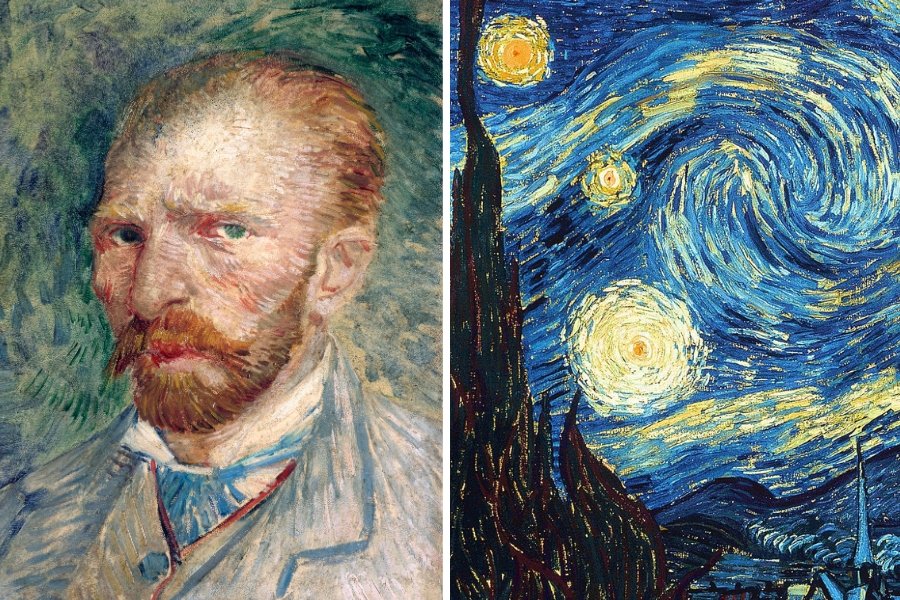
In 1889, van Gogh was admitted into a mental asylum outside Saint Remy, France. But unlike the overcrowded public mental institutions in large cities, the small asylum only had 41 patients and was run by a progressive doctor who believed in treating mentally ill people with kindness and understanding. Art and nature were seen as healing, and doctors quickly realized that van Gogh wouldn’t survive if he didn’t have the freedom to paint and create. He spent all of his waking hours painting and created many of his most well-known works—including “The Starry Night”—while gazing out his barred asylum window at the beautiful countryside dotted with olive groves and vineyards or wandering the purposefully planted gardens.
Most of the time, he was perfectly lucid and rational.
Today, van Gogh would likely be diagnosed with bipolar disorder, and his behavior during manic episodes—like cutting off his own ear and giving it to a prostitute—have planted in people’s minds a picture of van Gogh as a crazed lunatic. However, he was actually lucid and rational most of the time. Not only that, but he was intelligent and extremely well-read, spoke four languages, and had lifelong friends as well as a close relationship with his brother and sister-in-law. The history-defining ear incident was not his usual modus operandi. In fact, the video notes that he was “probably the sanest patient at St. Remy.”
Theo van Gogh, Vincent's younger brother, helped support him throughout his life. Public Domain
Van Gogh’s brother Theo was his biggest supporter.
Throughout his life, van Gogh’s younger brother Theo supported him in every way: financially, emotionally, and artistically. An art dealer himself, Theo encouraged his brother to develop his painting skills. Theo paid for Vincent’s treatment at the asylum and was also the one who insisted he be able to paint there. Much of what we know about van Gogh comes from letters he wrote to Theo, and the two shared a close bond. Theo was with Vincent when he died, two days after shooting himself in the chest. Theo, who also had syphilis, would die just six month later from the effects of the disease.
Van Gogh’s “The Starry Night” was influenced by Japanese art.
Like many of his Western colleagues at the time, van Gogh was influenced by art from Japan, and many of his paintings reflect elements of Japanese prints. He was an admirer of Hokusai’s “The Great Wave Off Kanagawa,” and it’s not a stretch to see how it may have inspired the swirl pattern and blue colors of “The Starry Night.”
Van Gogh tried to poison himself with paints and turpentine a few weeks before painting “The Starry Night.”
The bright colors that marked the last five years of van Gogh’s art also nearly took his life. New techniques in creating pigments in paints led to a dramatic shift from dark, brooding paintings to bright, colorful ones as van Gogh entered his peak years. But his mental health also took dramatic turns, and prior to painting “The Starry Night” in 1889, medical notes from the asylum indicate that he drank paint and turpentine as a suicide attempt.
Van Gogh became very religious but eventually lost his faith in Christianity.
Van Gogh was raised by a Christian minister father and developed a deep religious faith, even becoming an evangelical preacher himself for a time. But later his relationship with religion morphed into a belief that the divine was expressed in nature, art, and human emotion rather than the church.
Van Gogh considered “The Starry Night” a failure.
With his standards for himself set impossibly high, van Gogh felt that many of his paintings were failures, including, apparently, “The Starry Night.” He wrote to fellow
painter Emile Bernard several months after painting it, “I have been slaving away on nature the whole year, hardly thinking of impressionism or of this, that and the other. And yet, once again I let myself go reaching for stars that are too big—a new failure—and I have had enough of it.”
Van Gogh was entirely wrong about his own legacy.
Less than two months before his suicide in 1890, van Gogh wrote to a critic who had praised his work in a Paris newspaper, “It is absolutely certain that I shall never do important things.” Though he had started to see some success as an artist, there was no inkling that he would become one of the most famous and iconic artists of all time. If he had lived, he might have seen the full recognition of his artistic genius in his lifetime or he may not have. But as it was, he died believing himself to be an insignificant failure.
There may be many lessons we can glean from van Gogh’s story, but perhaps the biggest is to not discount our own talents, skills, or contributions. Like him, we may not be seeing the full picture.





 Add to Google News