This is an announcement with a link

A 92-yr-old former ballet dancer with dementia wrote this achingly beautiful poem about aging

Poetry can help people with dementia find their voice, and the results are incredible.

dementia, ballet dancer, poetry, poem, dancing
Photo credit: Canva"I am still a dancer made of song."

Poetry is an oft-misunderstood, but incredibly powerful art form. Humans have been writing poetry for thousands of years, communicating feelings and ideas in beautiful, powerful ways that prose just can’t quite reach. Poetry can be hard to define, but you know it when you see it—or rather, when you feel it.

Emily Dickinson once wrote, “If I feel physically as if the top of my head were taken off, I know that is poetry.” A poem hits you somewhere—your brain, your heart, your gut. And one poem that packs an incredibly moving punch has come from an unlikely source—an elderly woman with dementia.

elderly woman, dementia, caregiver, poetry, former dancer
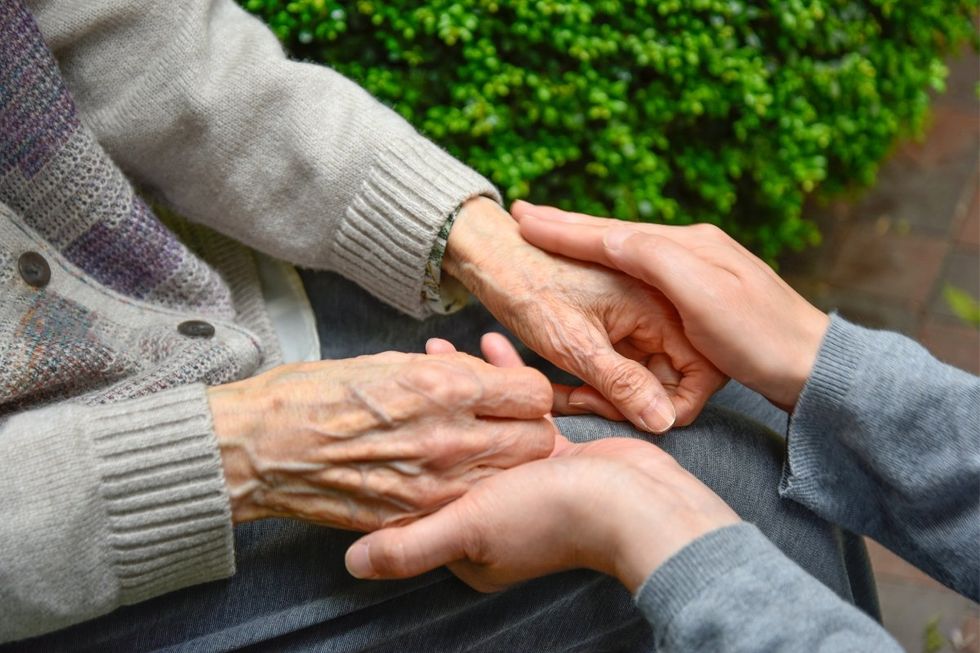
A woman with dementia wrote a poem with one of her children and it's bringing people to tears. Photo credit: Canva

Poet Joseph Fasano shared a message from a fan who shared that they had brought his book, “The Magic Words: Simple Poetry Prompts That Unlock the Creativity in Everyone,to their mother, a 92-year-old former ballet dancer living with dementia. The mother was excited to write a poem, and they slowly worked through a prompt from the book together aloud.

This poem was the result:

“Let the days be warm

Let the fall be long.

Let every child inside me find her shoes

and dance wildly, softly, toward the world.

I have a story I have never told

Once, when I was small,

I looked up at the sky and saw the wind

and knew I was a dancer made of song.

I am still a dancer made of song.”

Wow. What a testament to the power of poetry to reach beyond our usual modes of communication, which dementia so cruelly disrupts. In a few simple lines, we’re able to see this woman as she might see herself, as the human living under the veils of age and disease: “I am still a dancer made of song.”

Poetry prompts can help people express themselves

The person who shared the poem thanked Fasano for “helping people find their voices,” which is exactly what his book of poetry prompts was meant to do.

The Magic Words book by Joseph Fasano, poetry prompts


In the book’s introduction, Fasano shares that he’d been invited to speak to a class of second graders in New Jersey in 2022 to share “the craft and magic of poetry.” As part of his efforts, he came up with a poetry prompt that could “help guide their imaginations” and “unlock the images, thoughts and feelings inside them, without asking them to worry about how to structure a poem.” He called the results “astonishing.” When he shared one of the students’ poems on social media, it and the prompt took off like wildfire, as people who never thought of themselves as poets felt empowered to share their imaginations within that framework.

From 7-year-olds to 92-year-olds, anyone can benefit from the self-expression that poetry facilitates, but many people feel hesitant or intimidated by the idea of writing a poem. Fasano writes, “Poetry is what happens when we let ourselves be,” and this idea seems so clear than in the former dancer’s poem above. Dementia can create roadblocks, but poetry provides a different avenue of communication.

Caregivers try many different ways to communicate with people living with dementia. Photo credit: Canva

The arts can be a powerful tool for people with dementia

Using poetry to help dementia patients communicate and express themselves isn’t just wishful thinking. Studies have demonstrated that cultural arts interventions, including poetry specifically, can be beneficial for people with dementia. In fact, the Alzheimer’s Poetry Project (APP) aims to use poetry as a means of improving the quality of life of people living with dementia by facilitating creative expression. “We do not set boundaries in our beliefs in what possible for people with memory impairment to create,” the APP website states. “By saying to people with dementia, we value you and your creativity; we are saying we value all members of our community.”

Fasano has shared that a team of doctors has begun using his poetry prompts to “give people with dementia a voice again.”

Poet Gary Glazner, who founded APP, shared a story with WXPR radio about how he came up with the idea while studying poetry at Sonoma State University:

“I applied for a grant and got a grant to work at an adult care program. The moment I love to share with people is there was a guy in the group, head down, not participating and I said the Longfellow poem. ‘I shot an arrow into the air’ and his eyes popped open and he said, ‘It fell to earth I know not where.’ And suddenly he was with us and participating. It was just this powerful moment to see how poetry could be of use to elders but specifically with people with dementia.”

Whether we read it, write it, speak it or hear it, poetry has the power to reach people of all ages in all kinds of mysterious ways.

You can follow Joseph Fasano on Twitter and Instagram, and find his books on Amazon.

This article originally appeared last year. It has been updated.

  • Why people in Chicago are waiting hours in line to buy this man’s ‘terrible’ $5 portraits
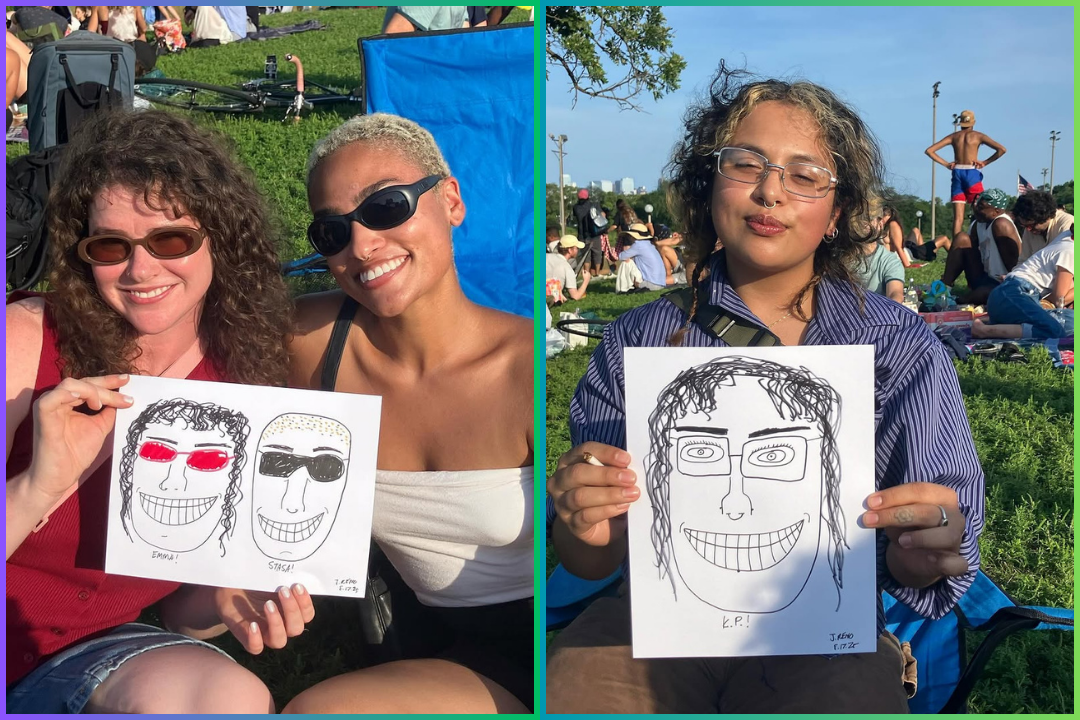
    Photo credit: Instagram (@terrible.portraits)Jacob Ryan Reno is creating something special in Chicago.
    , ,

    Why people in Chicago are waiting hours in line to buy this man’s ‘terrible’ $5 portraits

    “I am absolutely bewildered by the reception. I’m really astounded by it.”

    In a world increasingly dominated by AI-generated perfection and filtered faces, Jacob Ryan Reno’s art feels radical. The 26-year-old hit the delight jackpot, drawing large crowds to his “Terrible Art” stand, where he embraces his artistic inadequacy and, therefore, transcends into a viral sensation and profound joy.

    There’s no catch—he’s genuinely bad at portraiture. And people are lining up for hours to pay him for it.

    Every Sunday at Logan Square Farmers Market in Chicago, you’ll find Reno sitting next to a small, blue folding table. Leaning against it is an extensive hand-painted sign reading: “TERRIBLE PORTRAITS, $5.”

    Then, beneath in smaller handwriting: “5 TERRIBLE MINUTES.”

    It’s quickly clear that something extraordinary is taking place.

    How does one begin to describe Reno’s self-proclaimed “terrible” drawings? Is it performance art? A subversive act? Simply a man proudly owning his mediocre (at best) portrait skills?

    Armed with nothing more than art pens, poster board, and an unwavering commitment to never improving his craft, Reno charges $5 for five minutes of what he calls “an incredibly human experience.” His portraits feature elongated heads, jagged hair resembling haystacks, noses that look like wine bottles, and mouths drawn like bananas. Yet people line up eagerly, sometimes waiting hours for their turn to be immortalized in wonderfully wonky form.

    Reno’s sketches are crude, disproportionate, and “sometimes awkward.” Eyes bulge, pupils are dilated. Hair often seems like a messy afterthought. Teeth are drawn uniformly, like a pack of pearly, trident gum smiling up at you.

    “I am, indeed, a terrible portraitist,” the Chicago artist told As It Happens guest host Rebecca Zandbergen. “I have no intention of getting better. Actually, I intend to get worse, to be honest with you.”

    From house party disaster to artistic philosophy

    Reno’s journey into terrible portraiture began seven years ago at a DePaul University house party, where he studied screenwriting. What started as a simple drawing exercise with a friend turned into a pivotal moment for Reno when he produced a horrifyingly inaccurate portrait of his friend, and he looked “genuinely disappointed,” asking, “Is this how you see me?” The memory of that mutual laughter stayed with Reno through various career attempts, including a stint as a brand strategist that he left because it “didn’t align with my values.”

    Later, the rediscovery of that original terrible portrait last spring sparked an epiphany. “Something is interesting about this,” Reno recalled thinking. Over time, Reno’s whimsical experiment has evolved into a philosophical statement about authenticity, human connection, and the value of imperfection in our increasingly polished digital world.

    “I fully acknowledge that I am not a skilled portrait artist,” Reno told CBC Radio with characteristic honesty. “I have no desire to improve. In fact, I plan to decline further, to be frank.” This commitment to deliberate mediocrity isn’t laziness—it’s artistic rebellion against the pressure for constant self-improvement and digital perfection.

    Performance art meets community connection

    It’s important to understand that the portrait itself is only half the experience. Setting up his folding table with jazz music playing in the background, Reno transforms each sitting into a performance piece. He engages clients in genuine conversation, asking about their lives, relationships, and dreams while his pen captures their essence in wonderfully distorted form.

    “I want to make it as comfortable and as inviting an experience as I possibly can,” Reno explained. Here’s a little secret: although the timer may say five minutes, he almost always goes over, prioritizing the human connection over efficiency. This approach has created something remarkable: a community gathering point where strangers become friends through shared laughter at their own terrible portraits.

    One particularly touching moment occurred during his second week, when a nervous 10-year-old boy approached with $5 from his father. Despite Reno’s warning that the result might not be appealing, both artist and subject burst into laughter when the portrait was revealed. “We laughed for about two and a half minutes,” Reno recalled. “That moment was really a clear indication that this is something genuine and positive.”

    Reno’s viral success… and celebrity commissions

    Since launching his farmers market booth in May, Reno has completed approximately 600 portraits and gained massive social media attention. His Instagram account @terrible.portraits has attracted followers worldwide, leading to features on major news outlets including the Washington Post, Chicago Tribune, and CBC Radio. The phenomenon has even reached celebrity circles—Questlove has reportedly requested a commission, and the Chicago band Wilco invited Reno to sketch them before their performance at the Salt Shed.

    The viral nature of Reno’s work speaks to something more profound than mere novelty. In an era of AI-generated art and Instagram filters, his deliberately imperfect portraits offer a refreshing antidote to digital perfection. “I strongly believe in art being everywhere,” Reno said, “but I also worry that in an era of AI-generated art and ChatGPT, we might be losing the art of face-to-face communication.”

    This philosophy has resonated with clients who find the experience liberating. Victoria Lonergan, a former colleague who encountered Reno at a bar, described watching him work as both horrifying and hilarious. “When he flipped it around, it was just so funny. I think I laughed for five minutes,” she said, before framing the portrait and hanging it in her living room.

    The “terrible” empire is growing

    Reno’s success has naturally led to expansion beyond the farmers’ market. He now appears at weddings, birthday parties, and private events, bringing his unique brand of artistic mediocrity to celebrations across Chicago. His dream gigs include bar mitzvahs and quinceañeras, events where his ability to create joy through shared laughter would be especially appreciated.

    The wedding market represents a fascinating evolution of his work. While traditional wedding photography seeks to capture perfect moments, Reno offers couples and their guests something entirely different: portraits that are so deliberately imperfect they become ideal conversation pieces and icebreakers. As one couple from Lincoln Park noted after collecting not-so-flattering portraits from both Reno and a traditional Key West street artist, “at least you’re upfront about it.”

    Perhaps most remarkably, Reno has created a genuine community around his work. Regular market-goers know to expect him on Sundays, and his impromptu appearances around Chicago generate excitement among followers who never know where he’ll pop up next. The Reddit Chicago community has embraced him enthusiastically, with posts about his work generating hundreds of upvotes and comments from satisfied customers.

    The success of “Terrible Portraits” suggests a broader appetite for creative experiences that prioritize human connection over technical excellence. While AI can now generate flawless portraits in seconds, Reno offers something artificial intelligence cannot: genuine human interaction, shared laughter, and the beautiful imperfection that makes us most human.

    As Reno continues his terrible artistic journey, refusing to improve while paradoxically perfecting the art of joyful failure, he reminds us that sometimes the most beautiful thing we can create is a moment of genuine human connection—even if the portrait looks nothing like the person sitting across from us.

  • 5 ways people are going “All In” this week
    Copy of 5 ways people are going "All In" this week
    , , , , , , , ,

    5 ways people are going “All In” this week

    From the silly to the sentimental, there are so many ways people like to go “all in” on something. Here are our five favorite examples we found this week across the internet.

    When you hear the words “all in,” what do you think? You might picture an elaborately-themed birthday party for a dog, or maybe a person giving a detailed presentation on why she’s “Team Conrad.” (IYKYK) Or maybe you picture a woman who takes up running, showing up every day to push herself and completely changing her body and her mindset in the process. Whatever you picture, the idea is the same: Someone who does something with 100 percent total commitment. Going “all in” means giving your all—going completely over the top, no second guessing, no holding back. Just full-throttle enthusiasm, with some flair and creativity thrown in. And when people go “all in,” something truly special usually happens as a result.

    The internet abounds with examples of people giving it their all—whatever it is. In this roundup, we’ve found the very best examples of people going “all in”—moments where passion, creativity, and commitment take center stage. Some are sentimental, some are silly, but all of them are a reminder that giving 100 percent is truly the only way to leave a mark on this world. Get ready: These folks didn’t just show up, they went all in.

    Snag your free (!!) snack bars here while this deal lasts. Simply sign up with your phone number, pick two boxes of any flavor of All In bars at Sprouts, and then text a picture of your receipt through Aisle. They’ll Venmo or PayPal you back for the cost of one box. Enjoy!

Health

‘Fear-setting’: How a bestselling author conquers anxiety by writing down worst nightmares

Health

Doctor’s unique ‘4-7-8’ relaxation technique could help you fall asleep on-demand

Joy

Dogs really do have favorite people, and here’s how they decide who it will be

Music

Ethan Hawke puts the ‘Who’s your favorite Beatle?’ debate to bed forever in passionate exchange