The presumed father of a newborn baby was skeptical of his paternity after the baby girl was born with blonde hair and blue eyes. He and his wife of two years have brown hair and brown eyes, so he thought there was no chance it was his child.
The wife reassured her husband that they could have a blonde-haired, blue-eyed baby and that, quite often, a baby’s hair and eye color can change over time.
But the husband “freaked out at this and refused to listen,” the wife wrote in a viral post on Reddit’s AITA page. Instead, he “demanded a paternity test and threatened to divorce me if I didn’t comply, so I did.”
The man was so confident that after the baby was born, he moved into his mother’s house while he awaited the results of the DNA test. The wife stayed home with the baby and was helped through the first few weeks by her sister.
Couple after an argument. Canva Photos/
To make things worse, the wife’s mother-in-law began to make threats. “My MIL called and informed me that if the paternity test revealed that the child wasn’t his, she would do anything within her power to make sure that I was ‘taken to the cleaners’ during the divorce,” the mom shared on Reddit.
Finally, three weeks after the child was born, the DNA test results arrived and the husband came home to read them with his wife. “I was on the couch in the living room, so he sat next to me and we started to read the results,” she wrote. “They showed that he was the father and my husband had this shocked, kinda mortified look on his face with his eyes wide as he stared at it.”
The wife said, “I told you so,” and laughed in his face. In the post, the wife also notes she has “zero history” of cheating.
Although it is rare for two people with brown eyes and brown hair to have a blue-eyed, blonde-haired baby, it is entirely possible. According to Verywell Health, there is a 19% chance that a couple with brown eyes can have a blue-eyed baby. And, as the wife noted earlier, a baby’s eye color can change over its first year of life.
Further, two people with brown hair can have a blonde-haired child if both parents carry the recessive gene for blonde hair. The blonde hair may darken over time as well.
If the father had done a quick Google search on the topic, he would have quickly realized that there was a very strong case that he was the father and the drama could have stopped before any damage was done to the marriage.
The positive part of this story is that the wife’s post on Reddit earned her a ton of support from people who thought her husband’s antics were utterly inappropriate. The support probably also helped to put her husband’s wild behavior into perspective while she determined their future. The wife felt bad about laughing at her husband, but most people thought it was appropriate, given her husband’s initial response.
“Not only doesn’t he have a basic grasp of genetics, he threw a tantrum and left you immediately after having the baby to struggle alone for almost a month,” CrystalQueen3000 commented. “He’s lucky all you did was laugh in his face.”
A lot of commenters thought that the woman should leave her husband for accusing her of cheating and leaving her alone with the child.
“Honestly, if my husband left me for weeks after giving birth due to a faint assumption like this, I would be done. I can’t be together with someone who abandoned me when I needed them desperately,” another commenter wrote.
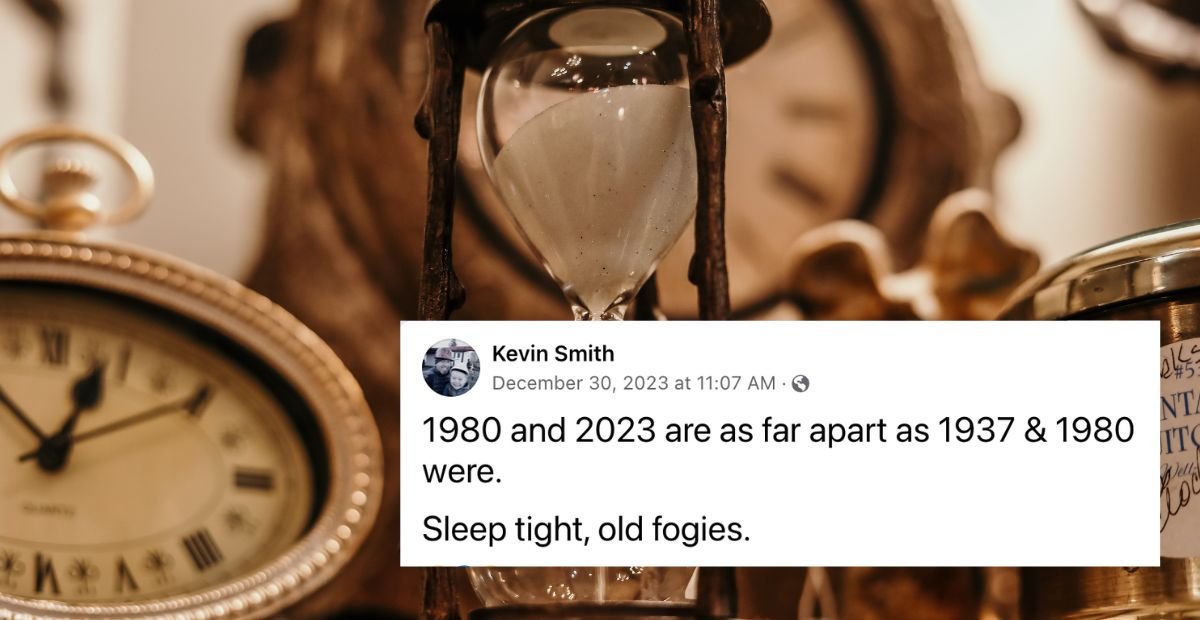
Imagine this scenario, if you will: You’re scrolling along, minding your own business on the internet, when this little nugget comes across your timeline: “1980 and 2023 are as far apart as 1937 and 1980. Sleep tight, old fogies!”
Wait, what? Your first reaction is, “That can’t be right,” so you pull out the calculator and do the math yourself—several times because you’re sure you must’ve missed a number somewhere each time. You remember how long ago 1937 seemed in 1980, and there’s absolutely no way that much time passed between 1980 and 2023. Buy you’re wrong. As the warped reality of time washes over you, you sit in stunned silence, contemplating the existential crisis you’ve just been thrown into.
Why does it feel like time goes faster as you get older? Is there a scientific reason, or does it just feel that way because we’re busy living life?
Why does time work this way? Why does it seem to get faster and faster and condense to make decades seem shorter and shorter as we age? And perhaps more importantly, how the heck do we stop time from feeling like a runaway freight train?
Here are a few theories about what creates the freight train phenomenon and what to do about it.
Time perception is relative—and kids perceive it differently
“Time flies when you’re having fun” is a saying for a reason. Time also drags when you’re doing drudgery work and feels like it stands still in moments of significance. And yet the ticking of seconds as they go by doesn’t change tempo. We measure it with steady, unchanging beats, but how it feels changes constantly.
This relativity exists in every passing moment, but it also exists in the bigger picture as well. The years felt like they passed by much more slowly when we were children, and by middle age, they feel like they pass in the blink of an eye. The pandemic gave us an even greater sense of this relativity as disruptions to our normal routines and the stress associated with the COVID-19 years messed with our sense of time. (On an odd side note, surveys show that our time perception during the pandemic varied a lot from place to place—people in some parts of the world felt that time moved more slowly, while others felt time moved more quickly.)
According to a 2023 Hungarian study published in Nature Scientific Reports, very young children perceive time differently than older children and adults. Researchers split 138 people into three age groups—pre-kindergarten, school-age and adults 18 and over—and showed them two videos of the same duration, one that was “eventful” and one that was “uneventful.” Interestingly, the pre-K group perceived the eventful video to be longer, while the older children and adults saw the uneventful video as longer.
The way the study participants described the length of the videos in gestures was also telling. Young children were much more likely to use vertical hand gestures, connoting volume or magnitude, to indicate a length of time than the other two age groups. School-aged kids and adults tended to use horizontal gestures, indicating time as linear, increasing with age.
Our neural processing slows down as we age
Professor Adrian Bejan has a theory based on how neurons process signals. As we age, our neural networks increase in size and complexity and, as a result, process visual information at a slower rate. That slower processing means we create fewer mental images each second than we did when we were younger, thereby making time seem to slow down.
“People are often amazed at how much they remember from days that seemed to last forever in their youth, Bejan shared with Harvard University. “It’s not that their experiences were much deeper or more meaningful; it’s just that they were being processed in rapid fire.”
In other words, processing the same number of mental images we did in our youth takes longer now, somewhat counterintuitively making time seem to pass more quickly. So goes the theory, anyway.
It might simply be about time-to-life ratios
Another popular theory about why time feels different as a child than it does as an adult is the ratio of any given day, week or year to the amount of time we’ve been alive. To a 5-year-old, a year is 20% of their entire life. For a 50-year-old, a year only is 0.2% of their life, so it feels like it went by much more quickly.
It’s also a matter of how much change has happened in that year. A year in the life of a 5-year-old is full of rapid growth and change and learning and development. A year in the life of a 50-year-old probably isn’t a whole lot different than when they were 48 or 49. Even if there are major life changes, the middle-aged brain isn’t evolving at nearly the same rate as a child. A 50-year-old looking back at the past year will have a lot fewer changes to process than a 5-year-old, therefore the year will seems like it went by a lot faster.
The key to slowing it all down? Be mindful of the present moment.
Lustig has a point. When we are in the moment, our perception of time is much different than when we look back. So, being fully conscious in the present moment can help us rein in the freight train effect.
One way to do that is to be mindful of your physical existence i
n this moment. Feel your heart beating. Feel your breath going in and out. Cornell University psychology professor Adam Anderson, Ph.D., conducted a study that found our perception of time may be linked with the length of our heartbeats. (Study participants were fitted with electrocardiograms and asked to listen to a brief audio tone. They perceived the tone as longer after a longer heartbeat and shorter after a shorter one.) He suggests starting a stopwatch, closing your eyes and focusing on your breathing for what you think feels like a minute. Then, check your time to see how accurate your estimation was.
“This can give you a sense of how much your experience of your body is related to your experience of time,” Anderson told WebMD. “It will help teach you to enjoy the pure experience of time.”
You can also use focused breathing to purposely slow down your heart rate, and thus slow down your time perception. “We show that slow heart rates—that is, a longer duration between heartbeats—dilates time, slowing it down,” Anderson said.
We can also alter our perception of time by taking in novel experiences, such as traveling to new places. According to Steve Taylor, author of Making Time: Why Time Seems To Pass at Different Speeds and How to Control It, people who go on adventurous trips report that their vacations feel longer than those who choose a predictable destination. You can also make small changes to your daily routine, such as trying new foods or taking a new route home from work to take in some new stimuli and slow your perception of time.
A study in 2024 found that people who do intense exercise experience a time warp, feeling like they exercised longer than they really did, so if you want to temporarily slow down time, you can push your body hard during a workout.
Finally, try to take in the world the way you did as a small child. Take note of life’s wonders. Engage fully in whatever you’re doing. Notice details and take mental pictures as much as you can. Time goes by fast when we’re distracted, so training our attention on the here and now can help. Ultimately, we can strive to perceive time more like we did when we were little, in its full depth and magnitude instead of a narrow, straight line.





 Add to Google News