This is an announcement with a link

15 unexpected signs someone is much, much smarter than you think

The smartest people are often funny and humble.

intelligence, signs of intelligence, smart people
Photo credit: via Associated Press/Wikimedia CommonsAlbert Einstein writing on a blackboard.

Can you quickly and easily tell how intelligent someone is? There are some obvious ways to determine if someone is highly intelligent, like when you see them work out a complex trigonometry problem on a blackboard or when they can easily explain the science behind mRNA vaccines or dark matter.

But there are also those we meet at social gatherings who immediately make us think they are very smart. Usually, it isn’t because they are making a long-winded speech about the fall of the Roman Empire or explaining quarks. We know they are intelligent because of the way they interact with people and ideas.

A Redditor named SomethingAbout2020 asked people on the AskReddit forum to share the “non-obvious signs” that people are intelligent. Many of their responses centered on highly intelligent people being open-minded, curious, and not wasting their time arguing with others.

Brilliant people are confident in what they know, consider other people’s opinions, and readily admit when they don’t know the answer.

What are 15 ‘non-obvious’ signs that someone is really smart?

1. They know what they don’t know

“They acknowledge areas where they lack knowledge.”

“‘Never pretend to know something when you don’t’ is something I always teach. It covers lying and ignorance.”

2. They consider other people’s ideas

“They’ll listen to the other’s facts and points and take them into account when giving an objection.”

“One of the best developers at my last job and manager of a project I was at is an extremely intelligent person. … One thing I noticed is how he would take everyone’s opinion into account. He would take my opinions into consideration even if I’m not a smarter person or know less about development.”

3. They make you feel smart

“Talking to a dumb person will make you feel smart. Talking to a smart person will make you feel dumb. Talking to a very smart person will make you feel smart.”

4. They see patterns

“Part of the reason smart people throughout history are well-known is because they discovered something new and figured out how to maximize its potential. Darwin was a guy who discovered a bunch of islands with slightly different animals. He then collected and analyzed that data to come up with the theory of evolution, which was largely correct. Einstein’s theory of relativity was based off of his observation that physics acted on everything equally. He figured out that “exceptions” were because of the way high-speed objects interact with the universe’s speed limit (the speed of light). He recognized these exceptions by gathering them and recognizing the pattern between them all, then created his theory of relativity based on that.”


intelligence, painter, paint brush, mural artists, curiosity
A painter making a mural. via Canva/Photos

5. They consider multiple intelligences

“They realize not everyone is smart the same way. Your ‘stupid hick neighbor’ might have dropped out of school in 8th grade, but he can drive your car once and tell you exactly what’s wrong, then fix it. That a**hole in school that had no empathy for anyone and showed no emotion made that sci-fi sh*t you thought would never be real. Yeah, she’s dingy and her worldview is tiny, but she’s the best teacher you’ve ever met and inspires tons of kids to go on and do great things with themselves. There’s no one-size-fits-all answer here, really.”

People who are super bright are probably familiar with Howard Gardner’s theory of multiple intelligences. The theory suggests that people have more than just one type of just one type of intelligence, like being good at mathematics. Gardener says there are several, including musical, spatial, linguistic, interpersonal, intrapersonal, and kinesthetic intelligence. This theory allows people to appreciate different forms of intelligence that may not be of the academic variety.

6. They choose their battles

“When another person is not able to process something and, therefore, sticks with his opinion, after a few tries, the smart person just gives up. There is no use in trying to make someone understand something while they already have an uneducated opinion.”


7. They speak to their audience

“They know how to explain concepts on just about any level, tailoring that level to their intended audience, and without coming across as condescending in any way.”

“I heard a saying that went ‘you have to be an expert to explain it simply.’”

8. They’re confident in their intelligence

“Not constantly bragging about their intelligence. If they truly are smart, people can figure that out pretty quickly without them doing anything to show it.”

“You generally only brag about things you’re insecure about because you seek validation. If you are very comfortable with your intelligence, then you may not care if someone misinterprets you and makes you look dumb or something. You have nothing to prove. That’s not just for intelligence but for anything.”

9. They’re funny

“I think the smart people are even more funny than stupid people because smart people understand the complexity behind humor and can make their jokes reflect that.”

Scientific studies show that funny people, especially those with a dark sense of humor, are more intelligent than their not-so-funny peers. Researchers argue that it takes cognitive and emotional ability to make people laugh, and analysis shows that funny people have higher verbal and non-verbal intelligence.

laugh, humor, sense of humor, jokes, men in suits, moment of levity,
A man laughing at his friend's joke. via Canva/Photos

10. They mind their own business

“This is a big one. They keep to themselves and deal with their own drama.”

11. They aren’t necessarily great students

“Believe it or not ‘average’ or ‘above average’ students are often smarter than those with straight A’s on the report cards. They do enough to pass well and get what they want but don’t let the academic system control them. Life isn’t all about booksmarts. This shows they are independent thinkers and don’t get wrapped up in designed systems. Not all, but many. Many kids who are forced to always be exceptional in school can end up the worst off and can develop deeper issues.”

12. They are good listeners

“They actually listen to who they are talking to as opposed to waiting for their turn to talk.”

13. Curiosity

“It really does seem to be one of the single greatest differentiators between average and smart.”

A meta-analysis of over 50,000 students from around 200 separate studies found that students who are curious do better in their school work over those who are not. Why is curiosity so important when it comes to IQ? “Curiosity is basically a hunger for exploration. If you’re intellectually curious, you’ll go home, you’ll read the books,” Dr Sophie von Stumm, the study’s first author, said. “If you’re perceptually curious, you might go traveling to foreign countries and try different foods.”

14. Comfortable in silence

“Being comfortable enough to allow a moment of complete silence while you think when the natural instinct of most is to immediately start replying tells me that you are, at the very least, mindful of what you want to say.”

15. Unattached to their opinions

“Most of the smart people I know are not pushy with their opinions; by contrast, most of the opinionated people I know are flaming morons. I don’t know if there’s a correlation there, but my anecdotal experience has always been that the more eager someone is to state their opinion, the less that opinion is probably worth.”

This article originally appeared last year. It has been updated.

  • 11 helpful services your Costco membership offers that you might be missing out on
    Photo credit: Images via Canva/pixelfit, Leung Cho PanAll the extra benefits and services you get with a Costco membership.
    ,

    11 helpful services your Costco membership offers that you might be missing out on

    From insurance to check books, Costco has so many perks.

    Costco is all about offering its members deals. The mega store offers two different memberships—Gold Star (which costs $65 per year) and Executive (which costs $130 per year).

    “Members can stretch their savings even further with an Executive Membership,” Kristen Markel, founder of Warehouse Wanderer, a blog dedicated to Costco shopping strategies, tells Upworthy. “That tier earns 2% back on nearly all purchases—including travel and car rentals—so you’re essentially stacking an additional rebate on top of Costco’s already discounted rates.”

    To help save extra money, Costco members shared on Reddit their favorite lesser-known perks that they get out of their membership. Here are 11 Costco services you may be missing out on:

    Car rentals

    “When I need a car rental my first stop to check prices is always Costco Travel,” Melissa Cid, consumer savings expert for MySavings.com, tells Upworthy. “Costco Travel consistently has some of the lowest rates on car rentals! Members get a free additional driver included, which normally adds $10 to $15 per day. That perk alone can save you more than the cost of your annual membership on a single trip.”

    Travel (hotels, cruises, vacation packages)

    If you’re looking to take a vacation in the future, check out Costco Travel for additional deals on hotels, cruises, and vacation packages.

    “We used Costco Travel to book our Costa Rica vacation this Summer. I get overwhelmed planning those sometimes. They made it easy to do, and they gave us a $200 gift card when we returned!” one member shared.

    Pet insurance

    If you have a furry friend at home, look into pet insurance options.

    “This perk can save pet owners hundreds of dollars a year on unexpected vet bills, while also giving them round-the-clock peace of mind,” Tom Bean, VP of insurance services operations at Figo Pet Insurance, tells Upworthy.

    Auto and home insurance

    Insuring your car and home are additional perks that Costco provides its members, who may also be eligible to receive additional discounts and benefits, such a roadside assistance, home glass repair reimbursement, and more.

    Prescriptions

    Costco’s pharmacy has very low prices on generic prescriptions, sometimes even cheaper than insurance copays, and the same applies to many pet medications,” says Cid. “Even over-the-counter medicine cabinet staples like allergy pills are dramatically cheaper than at drugstores. I buy a bottle of Kirkland allergy medicine at Costco for 75% cheaper than generics at my grocery and drugstores.”

    Discounted gift cards

    “Costco members can score $100 in gift cards for about $80, and the selection includes not only restaurants and Uber Eats but I’ve even bought discounted Disney gift cards before!” says Cid. “If you want an easy way to save 10-25% off at a store, restaurant or entertainment then definitely checkout the current Costco gift card offerings. The physical gift cards offered in-store are great for presents around the holidays. When shopping online, the e-gift cards are quick to order for yourself for immediate use!”

    Checks

    If you frequently write checks, you can order them through Costco rather than your bank.

    “I’ve ordered check books for my mom. Like 75% savings vs ordering them through my bank,” one member shared.

    Home improvement

    Need to get some repairs done on your home? Costco offers home improvement services.

    “I got a heat pump system installed by a vendor and got a great price,” one member shared. “I could run it through the executive card and get cash back. About 2 years later the compressor went out. It was from a bad install and the hvac company wanted to charge me a thousands to replace it. I escalated through the ranks of the hvac company to no avail. One call to Costco corporate to complain was all it took- the hvac company apologized and replaced it for free. I appreciated having the heft of Costco behind me to make them do the right thing.”

    Another added, “Replaced our garage doors through a preferred vendor. It was literally the exact same door we had quoted from another company, but cost was 25% lower not to mention all the rewards on top.”

    And another member shared, “I purchased a garage door and opener through them. Worked out well and got a 15% shop card.”

    Auto purchases and repairs

    You can buy a brand new or used car through Costco’s Auto Program, which also offers discounts on parts and repairs, including tires.

    “I bought my car via Costco,” one member explained. “Went into the dealership knowing what I wanted to pay and they basically offered exactly that. I showed up with my own financing and the entire process was super easy. Would absolutely do it again.”

    Hearing aids

    Costco also has a Hearing Aid Center, where members can have their hearing tested and purchase hearing aids.

    “Friend of mine was just telling me about his experience with them with their hearing aids – super great experience and cheaper too,” one member wrote.

    Vision testing, glasses, and contacts

    Another perk Costco offers is Costco Optical, where members can have their vision tested and purchase glasses, sunglasses, and contact lenses.

    “Just got TWO pairs of glasses w progressive lenses — one progressive lenses w all the coatings and one progressive polarized sunglasses (the exact tint I wanted) — in name brand frames for under $450!!!” one member shared.

  • To chat or not to chat? The unclear etiquette of airplane conversation and how to navigate it.
    Photo credit: CanvaPeople have strong opinions about chatting on airplanes.
    ,

    To chat or not to chat? The unclear etiquette of airplane conversation and how to navigate it.

    Being trapped next to a stranger in the sky is a unique social situation.

    Is there any social situation more inherently awkward than sitting next to a stranger on an airplane? It’s not like a bus or a train, where you can get up and change seats if you’re not thrilled with your seatmate. And with airplane seats getting increasingly cramped, you’re inevitably invading one another’s personal space in some capacity. Where else in life are you quite literally trapped for hours in such close proximity to someone you’ve never met and are unlikely ever to see again?

    Some people enjoy making small talk on flights, finding it the most natural thing in the world to chit-chat with the person sitting next to them. Others find the prospect of talking to a stranger with no opportunity to escape the stuff of nightmares, and do everything they can to avoid it.

    Since you never know who you’re going to sit next to, it’s like a game of roulette, and people tend to have pretty strong opinions on their own preferences. But are there any actual rules of etiquette that come into play for chatting with strangers on airplanes?

     airplane, air travel, flight, airplane etiquette, talking to strangers, social cues
    Some people love chatting with strangers. Photo credit: Canva

    The biggest “rule” is to pay attention to one another’s social cues, which is easier for some people than for others. Most people make it fairly obvious if they are open to conversation. If someone is wearing earbuds or headphones, that’s a clear indication that they are not really interested in chatting. If someone is reading, a brief greeting is appropriate, but then let the person continue the conversation if they want to. If the person looks at you and smiles, there’s a good chance they’re down for shooting the breeze, at least a little bit.

    But what if you’re on the receiving end of someone’s eagerness to chat and you don’t really want to? You can use headphones or earbuds, but if you don’t have any or prefer not to wear something in or over your ears, there are other options. Reading a book or looking at your phone sometimes works, though a lot of people will still offer a greeting. You can indicate that you’re not really up for conversation by responding to any additional chit-chat with polite, one-word answers and avoiding reciprocating with “How about you?”

    There’s also nothing wrong with saying, “I’m going to read/watch a movie/sleep/have some quiet time now,” if someone isn’t picking up your cues. It may feel awkward to be direct or not reciprocate if you’re accustomed to standard small talk, but the social situation on an airplane requires different approaches.

    airplane, air travel, flight, airplane etiquette, talking to strangers, social cues
    Earbuds and reading are cues that someone's not up for a conversation. Photo credit: Canva

    Is it rude not to talk at all? Is it rude to ask people questions about themselves? In reality, there are no clear right or wrong answers here. The only thing that’s actually rude is ignoring someone’s cues that they don’t want to talk. A brief greeting is generally polite, but beyond that, it’s really up to the people involved to determine whether the plane ride will be spent in side-by-side silence, engaging conversation, or something in between.

    Of course, some people go as far as to say you should “always” or “never” strike up conversations on airplanes, but most of us fall somewhere in between. It might even vary individually from flight to flight—maybe you’ve had a long trip or a hard day and want some solo reflection time, while at other times you might be feeling more social and enjoy some human interaction.

    The most important thing is to recognize that there’s a huge spectrum of preferences on this front. Just look at how these takes from a Reddit discussion on this topic differ so drastically:

    “When you are boarding, it’s acceptable to let someone know you are sitting next to them, or perhaps say a simple hello. You should always treat others with courtesy, particularly the flight crew (eg, politely letting a seat mate know you need to use the restroom, placing a drink order). And it’s occasionally ok to strike up a conversation while deplaning as the other person is no longer trapped. Other than that, quietly keep to yourself.

    The chances the person next to you just wants a moment to themselves is high. They had a long work trip. They are returning from a funeral. They are leaving school after finals. Even if they are relaxed, the chances they want to spend the flight speaking with a stranger who has a solid 50% chance of being insane is also low. No good can come of cornering someone in a tiny metal tube with no escape at 30,000 feet for multiple hours. It can only make someone feel trapped, desperate, and claustrophobic. And we’d all rather just listen to music, work, or watch a movie.” LazyConstruction9026

    airplane, air travel, flight, airplane etiquette, talking to strangers, social cues
    Some people want to be left alone on flights. Photo credit: Canva

    “Yeah chatting with someone on a plane is a great way to make the time pass quickly. It’s also really easy to tell if someone’s into it and if they aren’t I just do something like watch a movie or play my Switch.

    I’d have missed out on a lot of cool people’s stories if I didn’t strike up a random convo on the plane. One person was headed to Me
    xico for a month to be the first to climb a 14-pitch 5.14b they had there with no falls. A father was moving him and his family from Canada back to Mexico to run a church/shelter. Then there was a dude from Norway that talked about how he was working at Disney in a Norway-themed restaurant for a year which was super interesting to learn the logistics of.

    There’s a lot of cool people out there that are open to conversation and have awesome stories to share that make the time fly.”Romestus

    “I was on a 16 hr flight from Dubai to NZ and ended up sat in between an old kiwi farmer from the South Island and an old kiwi farmer from the far north. They got on like a house on fire. They apologised for talking over me probably 50+ times but truthfully I was overjoyed to hear their life stories and watch them become friends and ultimately exchange phone numbers. At some point we established that all 3 of us were returning home from watching the America’s Cup in Barcelona, and all shared about our relationship with sailing and team NZ. It was honestly delightful.” southernkal

    “I sit and stare at the seat back in front of me for the whole flight regardless of the length. I have done this forever. I like being alone with my thoughts and it is relaxing for me. I do not want to speak with anyone. It probably looks like I am bored so people start speaking at me. After a few one or two word answers they usually get the idea.”Pawlyplaysthebanjo

    “I talk to people almost everywhere I go, but I can also understand when someone isn’t interested in chit chat. I’ve gotten job doors opened through plane convos, mentors, and feedback on all manner of things. I’m a social person obviously, and love meeting new people and learning about them – but I also understand not everyone is, even if it makes me sad to sit in silence for an entire flight.”Plastic-Anybody-5929

    airplane, air travel, flight, airplane etiquette, talking to strangers, social cues
    The key is to read people's cues. Photo credit: Canva

    “I had to catch too many flights this year due to two very significant deaths in my family. One of them required flying while my mother was on her deathbed. There was no way I wanted to talk to anyone and I’m glad that no one did. I needed that time to process and ground myself because of what I was going through. I’m not sure if I looked unapproachable or if people thought me rude. But I emotionally and mentally could not stand small talk.” invadergirll

    “I love talking to people in airplanes, airports, etc. but sometimes I don’t want to talk, either. If they don’t seem interested in chatting- I don’t push. Once they put their earbuds in or start looking for something to read or watch, done. If they want to chat though- great!”Born_blonde

    You never know what people are going through and why they might want to or not want to talk. Plane chatting etiquette really boils down to reading people’s cues (or learning to do so if it doesn’t come naturally) and respecting when someone doesn’t want to engage in conversation. In a cramped capsule at 30,000 feet, we definitely need to give one another plenty of social grace and space.

  • ‘Credit cards are not money’: 11 financial lessons from smart women who learned the hard way
    Photo credit: CanvaWoman holding money.
    ,

    ‘Credit cards are not money’: 11 financial lessons from smart women who learned the hard way

    Wisdom from savvy women who’ve been there—so you can skip the financial heartbreak.

    Money conversations between women are essential. This is where women can drop their guard, admit their mistakes, and share the lessons they have learned at a high cost.

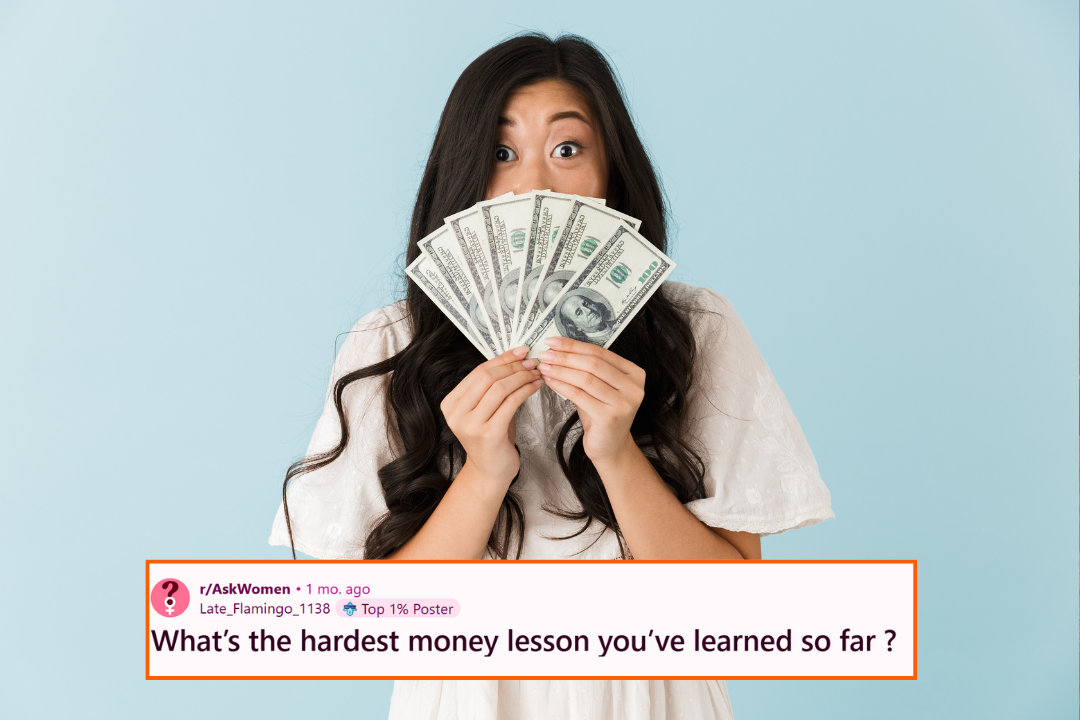
    Recently, a powerful discussion erupted online when women on the subreddit r/AskWomen were asked a simple question: “What’s the hardest money lesson you’ve learned so far?” The responses were raw, honest, and surprisingly universal—revealing financial truths that every woman should know before learning them the expensive way.

    These aren’t just money tips; they’re survival strategies from women who’ve navigated financial hurricanes and emerged stronger.

    Here are the 11 lessons that repeatedly emerged, each one carrying the weight of experience and the power to transform your financial future:


    1. Build your emergency fund like your life depends on it (because it does)

    A recent survey conducted by U.S. News revealed a shocking truth: Two in five Americans (42%) do not have an emergency savings fund. Even more dismaying, nearly as many (40%) couldn’t cover a $1,000 emergency expense with cash or savings, though 60% said they’d had an “unexpected expense pop up in the last year.”

    Unfortunately, a massive part of the problem is a gender wealth gap: nearly half of all women (49%) don’t have an emergency fund, compared with just 36% of men who don’t. They also have lower balances. Among women who do have emergency savings, the median balance is $6,500. It’s $11,000 among men.

    However, data revealed that emergency savings are the strongest predictor of financial well-being. Findings from Vanguard research indicate that having at least $2,000 in emergency savings is associated with a 21% higher level of economic well-being compared to not having any emergency savings.

    money, emergency, funds, financial, literary
    Emergency funds are crucial. Photo credit: Canva

    “Emergency funds aren’t optional,” warned one Reddit user. “Life will throw curveballs when you least expect them.”

    Another person chimed in, “Yup, my husband lost his high-paying job when I was eight months pregnant. I’m about to give birth and still have no job.”

    Then, a separate woman: “[I was] just driving and swerved to avoid [hitting] a rabbit. I hit the curb and needed new tires the same week I needed expensive dental work. Literally every dollar of debt I’ve been paying off this year just tacked right back on.”

    2. Never make someone else your financial safety net

    Too many women learn this lesson through divorce, job loss, or relationship endings. Financial dependence isn’t romantic—it’s risky.

    “Make your own money. Even if you meet someone wealthy who pays the bills, being able to say f*ck off is priceless ☺️” wrote one person on Reddit.

    Another echoed this sentiment, writing, “And have things in your name. Build your own credit. Lease your own vehicle. Financial abuse and manipulation in relationships is devastating.”

    Reflecting on their past, someone else replied: “It’s so important to have credit in your own name. I stupidly got rid of all my credit cards when I was a stay-at-home mom, and it’s taken me eight years of paying bills on time to achieve a good credit score finally. No credit is worse than bad credit. You never know what curveballs life will throw at you.”

    3. Bank approval doesn’t mean you should say yes

    “Just because you’re approved for it doesn’t mean you can afford it,” warns one Reddit user. “Congrats! You’re approved for a $500K mortgage! But can you afford $3,500 a month just for the mortgage? (On top of all the other house costs, like food, clothes, electricity, and water?)

    Another person chimed in: “THIS! My Husband and I sat down and did the math on ‘Here’s what we make, here’s what we owe, here’s what we can afford for our monthly mortgage to be.’ Then we went to a mortgage lender, and they ran their program, saying they’d give us a loan for twice what we knew we could afford. I’m so glad we did the math ourselves first and didn’t take their word for it, or we’d have been headed to foreclosure for sure!”

    Here’s the cold reality: Banks make money from your debt. A pre-approved credit limit or loan offer isn’t a financial blessing—it’s a business opportunity. Banks see your income and think “customer potential,” not “what’s best for this person’s financial future.”

    Try the 48-hour rule: wait two days before accepting any credit offer, and ask yourself if you actually need it.

    4. Lending money often means losing money

    Mixing money with relationships is like mixing oil and water—it doesn’t make sense and often creates an entire mess.

    That $500 loan to a friend often becomes a $500 lesson about boundaries. Before lending money to anyone, ask yourself if you can afford to lose it completely. If the answer is no, the answer to the loan request should also be no. A simple, “I’m sorry, I can’t lend you money,” is a complete sentence and a complete answer.

    “Don’t lend money unless you can afford to never get it back,” writes one replier. “I lent someone over $5,000, and when I asked for it to be repaid, she blocked my number and ghosted me.”

    5. Credit card debt is quicksand

    Credit cards aren’t emergency funds—they’re expensive traps. A recent Experian survey found that nearly 25% of Americans are struggling to manage their debts. Meanwhile, LendingTree reports that the average APR offered with new credit cards is 24.23%.

    One Reddit user recommends using a 0% APR credit card to reduce your credit card debt. “0% APR is good,” they write. “Create a calendar reminder to remember when it ends. Before that [date], pay off your credit card bill and use it like a debit card. If you can’t pay it within two weeks, don’t use it. Pay off your card twice a month.”

    credit, cards, financial, literacy, women
    Credit cards are a slippery slope into debt. Photo credit: Canva

    This echoes Experian’s advice for paying down debt and improving financial literacy. They endorse the 50/30/20 budget, which allocates 50% of your net income for essentials, such as groceries and rent; 30% for discretionary spending, such as entertainment; and 20% toward savings and paying off debt.

    6. Trust, but verify—even in love

    It’s not fun to talk about, but financial infidelity affects relationships more than physical infidelity, according to financial therapists. Research also shows that women’s financial independence is an essential aspect of gender equality within heterosexual couples because it liberates women from fear of obligation to men. It’s been proven time and time again that financially dependent (versus independent) women are more likely to experience poverty, material deprivation, and marital instability.

    People online put it more bluntly: “Unfortunately, don’t trust your partner with your finances,” one writes. “Don’t take their word for it because they’re a liar. They’ve been lying to your face for a year. The savings you thought you had are all gone.”

    Another person replied, “As the partner that manages the money in my marriage, I second this so loudly. I’m responsible for our finances and trustworthy. But you shouldn’t trust anyone with your financial security. I make sure my husband is aware and involved. He doesn’t care, but everyone [else] should. If he wanted to leave me tomorrow, he should have access to funds to do so and the knowledge of how much there is and isn’t, how much debt we have, etc.”

    They continue:

    “Knowledge is power, people. Any investment decisions or purchases exceeding $200 must be discussed and approved by both parties. Even if your money is completely separate, it’s essential to know how your partner manages their own finances. Because you’re on the hook for their mistakes in some way/shape/form at the end of the day.”

    7. Your own bank account is non-negotiable

    “Keep a separate bank account with yourself as the only signer,” urges a Redditor. “You are not required to tell anyone that you have it. Consider keeping a joint account for communal bills with your significant other, but keep all other expenses in your own separate account. This wedding advice was given to me 20 years ago by my aunt, who has been happily married for 40 years. She was right then—and still is.

    Financial independence starts with financial access. Having your own account isn’t planning for divorce—it’s preparing for life. Even you need your own money in your own account. This isn’t about hiding purchases or planning an exit strategy; it’s about maintaining your financial identity and independence.

    As David Back, co-founder of AE Wealth Management, notes: “You should have your own account, both of you. It’s absolutely critical, especially for women, that you keep money in an account that’s yours that you control.”

    “8. “No” is a complete sentence.

    Women are socialized to be helpful and accommodating—often at the expense of their own financial security.

    “It’s OK to say no when someone asks you to loan them money,” one person reminds. “I have the hardest time saying no to friends and family, and have an even harder time asking them to pay me back. Now I just say, ‘I’m sorry, I don’t have any money I can loan you.’”

    Remember: You don’t need to justify, explain, or apologize for protecting your money. Whether it’s a loan request from family or pressure to cosign for someone, “No, I can’t do that” is sufficient. Your financial boundaries aren’t suggestions—they’re requirements for your security.

    9. Payday loans are financial poison

    Here’s a stat that will make your blood run cold: The annualized interest rate for a payday loan often exceeds 10 times that of a typical credit card. These loans cost $15-$30 per $100 borrowed, resulting in an annualized rate of 360%-780%, and they rarely help people build credit, often trapping borrowers in debt cycles.

    “Don’t take out a payday loan. Credit cards are not money. Don’t mess with the IRS. And most importantly, protect your credit score. That number is everything,” writes a woman on Reddit.

    Payday loans aren’t emergency solutions—they’re emergency creators. If you need emergency cash, consider exploring credit union loans, nonprofit assistance programs, or asking family before resorting to payday loans.

    10. Trust your bank’s romance scam warnings

    Have you ever received a financial request from a stranger on social media or a dating app? Maybe posing as an old classmate or a potential romantic match, these predators work their magic on you—being charismatic, gaining emotional trust—before things take a turn, and they suddenly ask for money, citing a medical emergency, travel expenses, a lost passport, or a frozen bank account.

    Sadly, this is the classic setup for a romance scam—a dangerous and growing form of fraud that preys on emotions. Corebank reports that victims often “lose hundreds or even thousands of dollars, believing they are helping someone they deeply care about—only to later realize they were deceived.”

    A banker on Reddit warns others of romance scams, writing: “If your bank tells you it’s a suspicious account and refuses to send your wire transfer, trust them! You are susceptible to romance scams.”

    woman, stressed, money, financial, literacy
    Don't stress yourself out over a romance scam. Photo credit: Canva

    Another shares, “My best friend fell for one of these. We’re all dumbfounded because she’s smarter than that. She didn’t listen to any of our warnings. I’m not sure if the bank tried to warn her, but if they did, she didn’t listen. “

    Corebank also found that romance scams disproportionately affect individuals over 55 years old (52%), which isn’t to say that younger demographics are immune to their charms, with 11% of victims falling between the ages of 18 and 44.

    How bad is this problem? According to the North American Securities Administrators Association (NASAA), romance scams, also known as confidence scams, are a growing problem in the United States. In September 2021, the Federal Bureau of Investigation (FBI) issued a warning that its Internet Crime Complaint Center (IC3) had received more than 1,800 complaints related to online romance scams, resulting in losses of over $133.4 million.

    Make sure to protect your heart—and your wallet!—while talking to people online!

    11. Permission to spend money on yourself, granted

    Sometimes, the best financial advice for women is: to spend your dang money.

    “I grew up poor, like, ‘electricity was off sometimes’ poor,” recounts one woman. “Now, with my fiancé—who loves to spoil me—it’s so hard for me to let him spend money on me. He can buy me a soda, and I’m like, ‘But it’s $3…’ I’m constantly asking him, ‘Is this OK?’ when I get something. [I’ve learned from him] that it’s fine to say, ‘Money comes, money goes.’

    Where does this guilt come from?

    The UN reports that when women work, they invest 90% of their income back into their families, compared with 35% for men.

    You don’t need to earn every purchase through suffering or justify every treat. Spending money on yourself isn’t selfish—it’s necessary. Whether it’s the massage that helps you recharge or the course that advances your career, investing in yourself is investing in everyone who depends on you. Build “personal spending” into your budget and spend it guilt-free.

    The bottom line: Your financial story starts here

    What’s beautiful about this thread is that these lessons weren’t learned in classrooms or from textbooks—they were earned through real experience, tough decisions, and sometimes painful mistakes. And what’s even better? You don’t have to learn them the hard way.

    Every woman who shared her story did so hoping to spare another woman the same financial heartbreak. Their wisdom is your shortcut to financial confidence.

    Pick one lesson that resonates most with you. Take one small action this week. Open that savings account. Have that money conversation. Set that boundary. Your future self—and every woman watching your example—will thank you.

    Because when women control their money, they don’t just change their own lives. They change everything.

Health

‘Fear-setting’: How a bestselling author conquers anxiety by writing down worst nightmares

Health

Doctor’s unique ‘4-7-8’ relaxation technique could help you fall asleep on-demand

Joy

Dogs really do have favorite people, and here’s how they decide who it will be

Music

Ethan Hawke puts the ‘Who’s your favorite Beatle?’ debate to bed forever in passionate exchange