Staying hydrated has never been easier thanks to reusable water bottles. But one of the biggest downsides to using water bottles is having to wash them. And if we’re honest, most of us probably go *way too long* between uses before giving them a deep cleaning.
You may be curious about how often you should be washing your water bottle—and the possible negative health effects that can happen if you neglect to. Unfortunately, if you simply rinse and re-fill without thoroughly washing with soap and water—it’s not cutting it.
“Wash it with soap and warm water at least every other day,” says Dr. Shanina C. Knighton, PhD, RN, CIC, Research Associate Professor, Frances Payne Bolton School of Nursing at Case Western Reserve University. She adds that if you drink anything beyond just plain water—such as adding lemon to water, adding flavor to it, protein drinks or coffee–then your water bottle should be washed immediately and daily.
“Sugar loves yeast, mold, and bacteria and when water bottles are left with fluids sitting in them for days odors can occur,” says Dr. Knighton.
Your water bottle can quickly become a petri dish as bacteria settles in, forming a biofilm (a slimy film or thin coating of germs). “This biofilm protects bacteria from casual rinsing, which is why that weird taste and smell develops even when you are ‘just using water’ to clean it out,” she adds.
Failing to properly wash your water bottle can lead to sickness as bacteria continues to grow and comes in contact with your mouth. “Unwashed bottles can harbor dangerous bacteria, including E. coli, Salmonella and Staphylococcus. Mold and yeast can accumulate in bottles that are stored while damp.”
Dr. Knighton adds that an upset stomach (nausea, vomiting and diarrhea) or food poisoning symptoms can stem from a dirty water bottle. “We know the impact of mold are attached to respiratory issues. Even something such as a rash around the mouth or skin infection can occur,” she says.
Warm water is best to clean your water bottle—and washing with cold water is not recommended. “Cold water does not break down bacteria or any oils and residues that may be in bottles,” says Dr. Knighton. “If the water is too hot, excessive heat can damage plastic or can weaken rubber water seals.”
You should also be hand-washing your water bottles. “I do not recommend harsh chemicals and the use of a dishwasher for water bottles. Given the depth of water bottles adequate cleaning may happen best if by hand,” adds Dr. Knighton. “I always suggest to check the manufacturer’s suggestions for cleaning.”
Dakota Johnson Snl GIF by Saturday Night Live Giphy
To properly wash your water bottle, you can also use vinegar instead of soap:
Fill your bottle halfway with white vinegar, top with warm water and let it sit for about 30 minutes. “It can help with any bacteria or crusty build ups that may be hard to reach inside of bottles,” says Dr. Knighton. She also suggests investing in a bottle brush to help you get to areas that are hard to reach with a sponge or dish towel, such as straws, lids or mouthpieces.
Always allow your bottles to adequately dry before putting the caps back on. “Hang them upside down on a rack where they are not touching the surface,” says Dr. Knighton. “If you put the tops back on them before allowing them to dry you are trapping moisture, which can become a breeding ground for germs.”
Finally, Dr. Knighton recommends that you replace your water bottles if you see any mold spots or if the rubber seals become worn down or hard to clean.
What if I told you the secret to success isn’t setting goals—but setting fears?
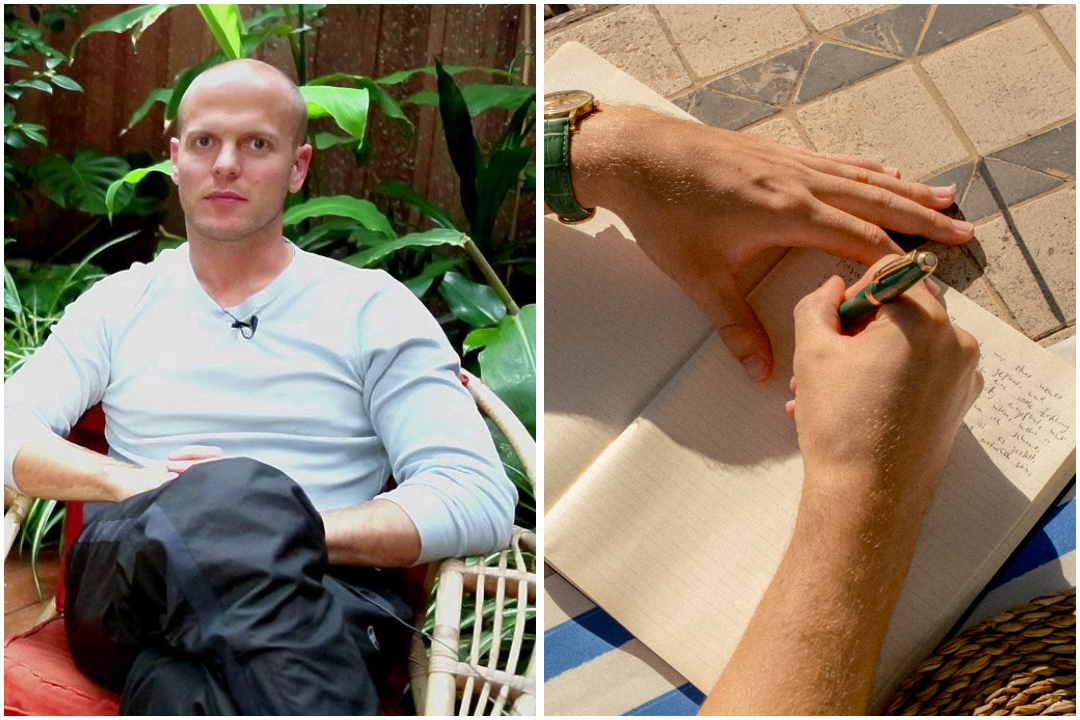
In a world obsessed with vision boards and goal-setting apps, bestselling author Tim Ferriss is dropping truth bombs that flip conventional wisdom on its head: “Defining your fears is more important than defining your goals.”
What?
This simple shift in perspective helped Ferriss change his life—and countless others—to break free from paralysis and take the bold actions he’d been dreaming about for years.
Welcome to the life-changing practice of fear-setting—a monthly ritual that could be the missing piece in your personal development puzzle.
Why our fears keep us stuck (and how to turn them into fuel)
Picture this: You’re lying in bed at 3 a.m., your mind racing about that “risky” career change you’ve been contemplating for years. The voice in your head whispers all the myriad ways it could go wrong—financial ruin, professional embarrassment, that meme of Marnie from Girls where she says, “Let’s make fun of the girl who took a risk and put herself out there creatively.” What if that were you?
But what would happen if we could flip the script? Instead of running from our fears, we could cut them open and realize that the monster we’ve been running from all this time was nothing more than a stack of clothes, piled up on a chair.
Enter Tim Ferriss’ fear-setting exercise—a systematic approach to transforming paralyzing anxiety into empowering action.
The 7 questions that changed everything
Tim Ferriss is an all-American multi-hyphenate: he’s an entrepreneur, author, podcaster, and one of the most influential figures in today’s productivity and lifestyle design space. Wiredcalled him “the Superman of Silicon Valley.” His multi-faceted empire includes five #1 New York Times bestsellers, including The 4-Hour Workweek and Tools of Titans: The Tactics, Routines, and Habits of Billionaires, Icons, and World-Class Performers. Ferriss also hosts the eponymous The Tim Ferriss Show podcast, the first business/interview podcast to exceed 100 million downloads. (It has now exceeded one billion downloads, by the way.)
In short, this is a person who knows a thing or two about high achievement.
Tim Ferriss revealed that he dedicates up to half an hour each month to confronting his fears head-on through seven critical questions. It’s a thorough and rational dissection of what scares him the most.
Question 1: What’s your nightmare?
Define your nightmare. What is the absolute worst that could happen if you followed through with what you’re considering?
Get specific. Avoid writing broad fears, such as “failure.” Remember, this is an activity designed to let your brain go into full disaster mode: use your creativity and imagination.
For example, you want to start painting, even though you know nothing about it and are “too old” to begin a new hobby. But what would happen if you took a class or started going to museums more often? Seriously, what’s the worst that could happen?
People start pointing and staring at you, the most out-of-touch person ever to exist? Your teacher comes to look at your work and starts laughing uncontrollably? Write it all down in painful detail. Then Ferriss advises, rate the permanent impact scale on a scale of 1-10. You’ll often discover that your worst-case scenarios aren’t life-ruiners—or, not even likely to happen at all.
Then, ask yourself: Would it be the end of your life? Are these things really permanent? How likely would they actually happen?
Question 2: How could you repair the damage?
If the very worst were to happen, how could you rebuild, even temporarily? Could you get your money back from the art institution? Leave a scathing review on Yelp? Go into therapy for your troubles? Often, we discover that the road to recovery is more possible than we imagined.
Question 3: What are the benefits of trying?
Ask yourself, what are the outcomes or benefits, both temporary and permanent, of more likely scenarios?
Fear-setting turns into sunsetting. Let’s change it up: even if you don’t achieve complete success (ex., your art teacher tears up when reviewing your first painting project and suggests someone should hang it in the Louvre), what could you gain just from putting yourself out there? New skills, confidence, friends, experiences?
Now, rate these benefits on a scale of 1 to 10 as well. Compare these with the numbers you provided in question #1. Are you shelving your dreams, a potential 9 (!), just because of an unrealistic fear that you rated a 3?
If you were fired from your job today, what would you do to get things under financial control?
Imagine this scenario and run through questions 1-3 above. If you quit your job to test other opportunities, how could you later get back on the same career track if you absolutely had to?
This question isn’t fear-mongering (remember, this is fear-setting.) It builds resilience by reminding you of your resourcefulness. Could you freelance? Take a part-time job? Sell possessions? You’re more capable of handling setbacks than you think.
Question 5: What are you putting off out of fear?
“Usually, what we most fear doing is what we most need to do,” Ferriss rationalizes. “A person’s success in life can usually be measured by the number of uncomfortable conversations he or she is willing to have.”
That phone call. A difficult conversation. That creative project. Fear of the unknown often prevents us from taking the very actions that could transform our lives. Define the worst-case scenario, accept it: then do it. Promise yourself to do one thing every single day that you fear.
What is it costing you—financially, emotionally, and physically—to postpone action?
This may be the most crucial question of all, says Ferriss. If you don’t pursue what excites you, where will you be in one year? Five years? Ten years? Inaction is the most significant risk of all.
Question 7: Well, what are you waiting for?
“If you cannot answer this without resorting to the concept of “good timing,” the answer is simple: You’re afraid, just like the rest of the world,” writes Ferriss.
In that case, it’s time to start again: Measure the cost of inaction. Realize the unlikelihood and repairability of most missteps. Develop the most critical action of those who excel and enjoy doing so: action.
Fear-setting is rooted in Stoic philosophy, specifically, the practice of premeditatio malorum: deliberately imagining potential hardships to reduce their psychological impact. Modern psychology confirms what the Stoics knew all along: when we define our fears with specificity, they lose their power over us.
Here’s why this approach is so practical:
It manages catastrophic thinking. Vague fears can feel like an ocean: overwhelming and impenetrable. However, specific fears are manageable.
It exposes the actual cost of inaction. No one likes losing or embarrassing themselves, but fear is a funny thing: we often ignore the losses that come from not acting.
Your action plan: 30 minutes that could change your life
“I am an old man and have known a great many troubles, but most of them never happened.” —Mark Twain.
Ready to try fear-setting yourself? Set aside 30 minutes this week. Grab a notebook and work through the seven questions above. Push yourself to be brutally honest: this exercise only works if you’re willing to confront your fears directly.
Tim Ferriss has used this exact process to make significant decisions in his life. And remember that lengthy paragraph earlier? Things turned out pretty well for him.
So, what do you have to lose? Apparently, the answer is “quite a lot.” Track down your favorite pen and get to fear-setting. Your future self thanks you.
Here’s a rhetorical, but important question: Are you having a hard time falling asleep? If so, you’re not the only one. Falling and staying asleep typically becomes more difficult as adults get older. We spend less time in deep sleep and REM sleep, and we struggle to fight off our worries and anxieties while lying in silence. Did you know there’s actually a name for the phenomenon where you keep yourself awake by lying there and wondering why you’re still awake? It’s called “spectatoring” and it’s incredibly frustrating.
Worse yet, the older we get the more likely we are to wake in the night and have trouble falling back asleep. This is why more and more Americans are turning to white noise, melatonin, meditation apps, special pillows, and anything they think can help them get most rest.
Fortunately, a doctor has shared the “most powerful” relaxation technique he knows, and it doesn’t require any equipment or cost a dime.
Dr. Weil is an expert in integrative medicine and the founder and director of the Andrew Weil Center for Integrative Medicine at the University of Arizona.
The technique is simple:
Breathe in through your nose while you count to 4.
Hold your breath while you count to 7.
Exhale while you count to 8.
It’s a unique protocol, especially when compared to another popular technique like Box Breathing. Box Breathing calls for an inhale, hold, exhale, and another hold of equal time (4 seconds). The extended exhale, in particular, is what makes Dr. Weil’s 4-7-8 so original.
Dr. Weil says the method creates a “very pleasant, altered state of consciousness” that you may not experience the first time but will come as a “reward” of regular practice. Dr. Weil insists that the 4-7-8 technique is a practice, and you must do four breath cycles at least twice a day to get the benefits. “After a month, you can increase to 8 breath cycles if you’re comfortable with it,” adding that’s the “absolute maximum.”
Dr. Weil says that 4 to 6 weeks of doing the practice can lower heart rate, improve blood pressure, digestion and circulation and can promote sleep. A study published in Physiological Reports agrees, saying that practicing the 4-7-8 technique reduces heart rate and blood pressure for several minutes. It’s important to note, though, that research is limited on the longterm benefits of 4-7-8 and experts urge us not to overhype it as more than it is.
4-7-8 is also an easy, fast, and effective way to help you fall asleep.
“If you get up in the middle of the night for any reason, it is the most effective anti-anxiety technique that I’ve found,” Dr. Weil says.
Deep breathing, interestingly enough, has been shown to increase melatonin production in our bodies; that’s the hormone that signals to our body that it’s time to sleep. Combined with its ability to calm our mind and body, it’s no wonder that intentional breathing exercises can put us to sleep in no time.
Why does deep breathing help us calm down and relax so effectively? There are a few reasons. First, when we’re stressed or anxious, our breathing naturally becomes more shallow and irregular. Breaking that anxious breath pattern signals to our body that things are OK, that we’re in control. Counting and being mindful of our breath also gives our mind something neutral to focus on instead of the usual chaotic images, intrusive thoughts, or worries. Third, deep breath settles down the part of our nervous system that controls our “fight-or-flight” response — and helps with elevated heart rate and muscle tension.
Remember again that 4-7-8 breathing is a practice. It can be used situationally to great effect, but for the best benefits its founder urges you to try it every single day for a cycle of 2-8 cycles.
This article originally appeared last year. It has been updated.
The human body is fascinating and, to this day even, full of mysteries. Did you know there’s a condition called Stoneman Syndrome where a person’s ligaments slowly transform into bones? Or how about Persistent Sexual Arousal Syndrome where a person lives their entire life on the brink of orgasm? Or how about Auto-brewery Syndrome, where a person’s gut biome naturally creates alcohol out of normal foods and beverages, thereby making them intoxicated without drinking a drop of booze?
The body is capable of extraordinary and extremely bizarre things, that’s for sure.
That was certainly the case when 20-year-old Savannah Stuthers went in for a relatively routine cyst removal that turned out to be anything but.
A female patient speaks with her doctor Canva
Stuthers dealt with months of cramps, pain, and even bleeding—which doctors told her was normal after having an IUD inserted—before she couldn’t take it anymore and took herself to the emergency room.
There, ER docs discovered a sizable cyst on one of her ovaries. Because the cyst was so large, the OBGYN at the hospital wanted to have it removed as soon as possible. Within a few days, Stuthers went under the knife.
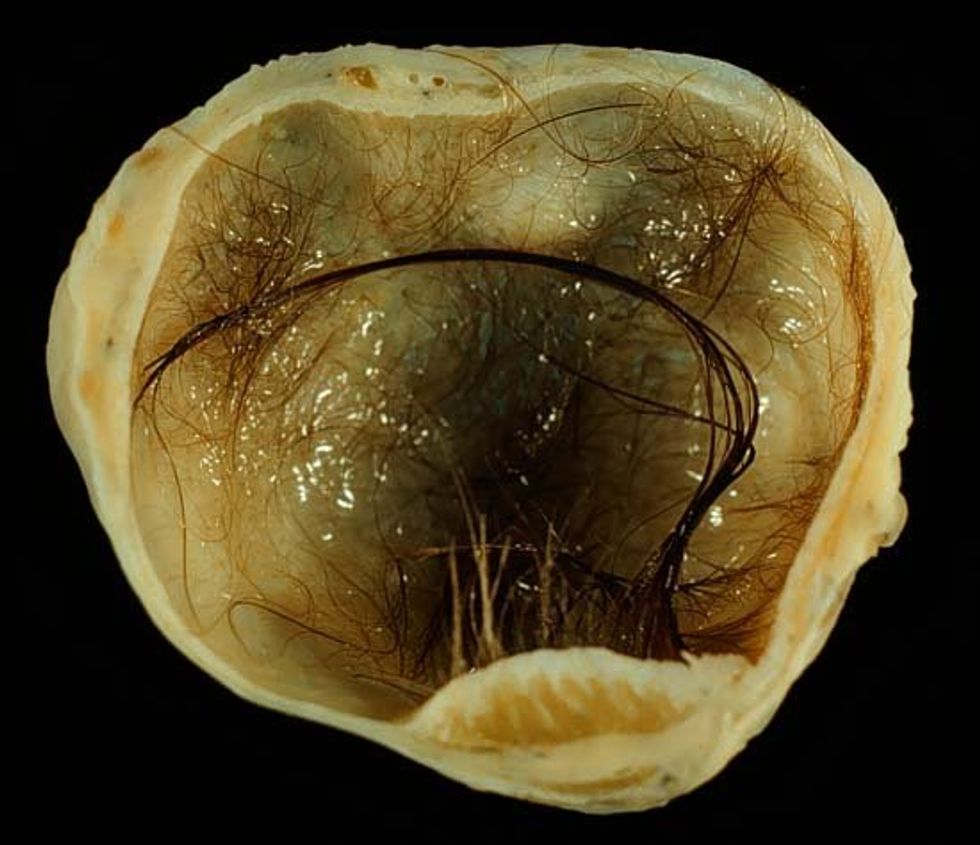
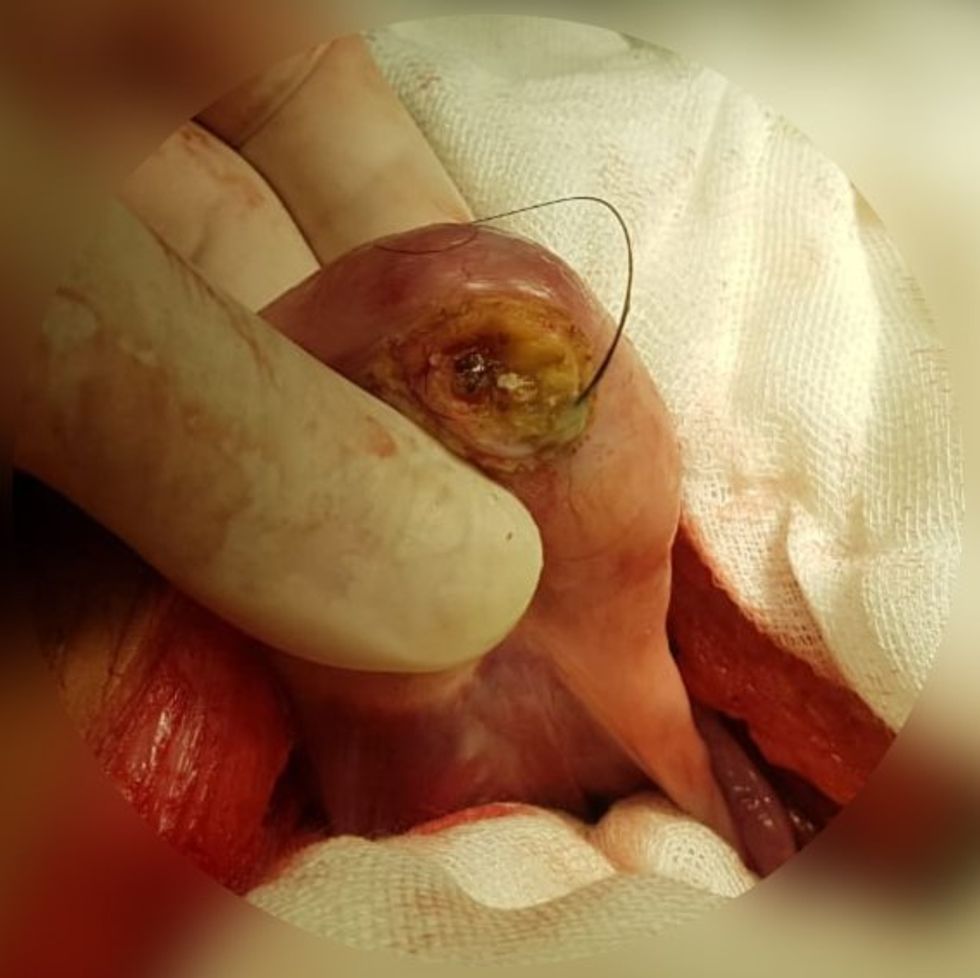
When she woke up from the anesthesia, the doctors had news. Her mom was there to capture the moment Stuthers heard that what was removed from her body was no normal ovarian cyst. It was a teratoma—a unique kind of tumor that grows from germ cells (cells that eventually become sperm or, in Stuthers’ case, eggs). Because of their origin, teratomas frequently grow hair and even teeth, along with various kinds of tissue. The teratoma inside Stuthers’ ovary had all that, and more… The surgeons even thought Stuther’s teratoma may have had an eyeball! (Later testing ruled this out… close call!)
Here’s the exact moment Savannah Stuthers learned what had been growing inside of her:
Stuthers posted the photo on TikTok where it went mega-viral to the tune of 34 million views. The morbid curiosity in the comment thread was absolutely off the charts. Many people had never heard of teratomas before, and most of them wish they still hadn’t.
“Girl I could have went my entire life without looking up what a teratoma is,” one wrote.
“I just looked at photos of teratomas and it made my arm get chills,” a user added.
“it’s crazy the body can actually create new eyes and teeth and THIS is what it chooses to use that ability for,” said another.
Other commenters were just here to applaud the teratoma representation:
“this happened to me, they removed my ovary with the teratoma and my surgeous said it burst on her I was the first surgery of the day”
“this happened to my sister but there were brain cells in hers, causing her anti bodies to fight off both the teratoma braincells as well as her actual braincells putting her in a coma for 4 months. it was awful.”
Of course, there were plenty of jokes, too:
“Why am I picturing Mike Wazoski from Monsters Inc???” one user said.
“Can we see it? ❌ Can it see us? ✅” joked another.
Mostly, people just wanted to know if they could see a picture of the actual teratoma. Stuthers did eventually show a photo briefly in a follow up video, but luckily for us, we can get a better look at these things through a plethora of high-res online images.
Ready? If you’re squeamish, you might want to look away now.
Stuthers was not about to let her newfound virality go to waste: She set right to work busting myths and misconceptions about teratomas.
Obviously, with 34 million viewers and many who had never heard of teratomas, she was going to get a lot of questions. She also got a lot of opinions that needed correcting.
“Those things form from sperm so tell your man to get a better pull out game or use protection,” one commenter said. In a response video, Stuthers simply wags her finger: Uh, no. Teratomas form from germ cells, which can turn into sperm, but they have nothing at all to do with sexual activity.
Another asked if the teratoma formed from a pregnancy gone wrong in the early stages. “So you would’ve maybe had a viable pregnancy but it didn’t make it down into the uterus.” Stuthers responded by citing that teratomas are actually congenital tumors, meaning they are present or begin forming prior to birth. So this was lurking in her body for a long time bef
ore it reached critical mass and had to be removed, and again, has nothing to do with her sexual activity whatsoever.
In an interview with Newsweek, Stuthers said that discovering the teratoma inside of her made her feel “gross.”
“It messed me up for a while thinking about how I never knew that it was there. In a way, it made me feel gross. The photo of the tumor truly altered my brain chemistry,” she said. But that couldn’t be further from the truth. Teratomas, while admittedly a little freaky and frightening, are really no different than any other kind of tumor. It’s their origin from germ cells which makes them capable of growing human tissue, teeth, hair, and eyeball-like structures.
But they’re understandably hard to talk about. And so as a result, the general public doesn’t understand teratomas very well. But Stuthers is working to change that with her follow-up videos on TikTok.
She also wants to encourage young women to advocate for themselves medically. Doctors dismissed her pain and discomfort for months before she finally went to the ER, and she’s urging women to trust their gut and fight for their own bodies:
“I got lucky as we found it in time so nothing too extreme happened. But I can’t help but think that if my doctors in Illinois would’ve listened, I would still have both ovaries. It is so important for women to express our pain and not allow doctors to invalidate us.”
This article originally appeared earlier this year. It has been updated.




 Add to Google News